Barging Through Burgundy: Week Two Of Our Adventure

FullSizeRender compressed 2
Daniele entering a lock on the Doubs river. © 2023 Ralph Grizzle

As I write this post, our tiny barge Daniele is leaving Dijon and headed toward the Saône river. The journey along the Canal de Bourgogne will take us just under two days. We’ll have many opportunities to step ashore for walks or bike rides on either side of the canal.

The locks, all 21 of them between Dijon and the Saône, serve not only to transport Daniele but also to allow us to step off and back on board. The way it works is that Daniele enters the lock with the lock’s front doors closed. Essentially, the barge is entering a basin. It’s similar to lowering yourself into a bathtub. Once Daniele is positioned inside, the lock’s rear doors close. Slowly the water level inside the lock lowers (like draining a tub) and the barge along with it. Once the water level inside the lock equalizes with the canal ahead, the front doors of the lock open. Daniele exits and voilà — we’re on to the next lock. This is the process for traveling downriver. It works in reverse going upriver.

FullSizeRender compressed 4
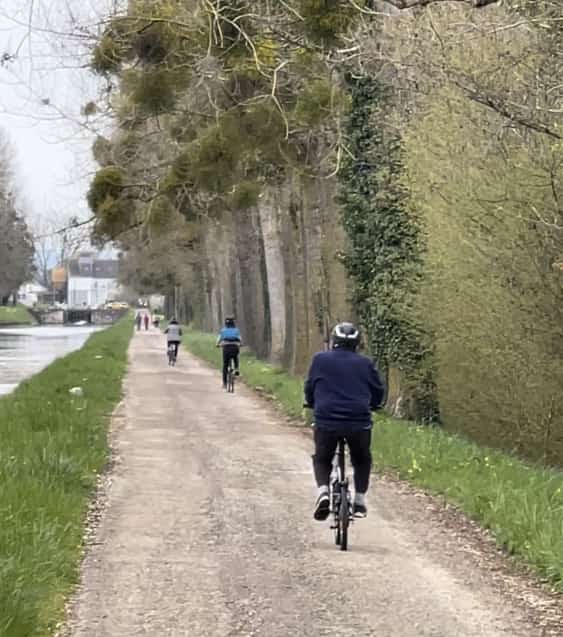
Everyone enjoys the action, including 87-year-old Mathew, cycling along the towpath on the Burgundy Canal. © 2023 Ralph Grizzle

The distance between locks ranges from a third of a mile to just under two miles. Mileage between locks is posted inside Daniele so that we can calculate how far we want to walk or pedal.

This morning, our skilled captain passed through the first lock without bumping the sides of the barge, a remarkable feat considering that the barge is nearly as wide and as long as the lock. It’s a tight fit to say the least, and our female captain, Fanny, takes her time to position Daniele inside the lock.

Transiting each lock takes up to 30 minutes. There are 21 locks along the 30-kilometer (18-mile) stretch between Dijon and the Saône. The going is slow — though Daniele is capable of nearly 20 kilometers per hour, her pace on the canal is about walking speed. We can easily keep ahead of the barge on foot or on a bike between locks. On the many barge trips I have hosted, I’ve not heard a single complaint about the pace being too slow.

FullSizeRender2 compressed 2
At lock (écluse) 65, a sign at the lock-keeper’s house shows that the distance between Dijon and Saint-Jean-de-Losne is nearly 30 kilometers, about 18 miles. © 2023 Ralph Grizzle

The Beautiful Burgundy Canal

The 242-kilometer (150-mile) Burgundy Canal itself is fascinating — and it is only one of many canals in France. Construction started in 1775, a year before 13 colonies declared independence from Britain. The canal was finished in 1832, completing the link between the English Channel and the Mediterranean via rivers and canals.

Were it not for the canals, there would be no barge trips in France. The French government maintains them primarily for recreational and touristic purposes, through the navigation authority known as Voies navigables de France.

You’ll see few, if any, cargo barges on the stretch between Dijon and the Saône. Railroads, rivers and highways are much more efficient at transporting goods. Those who have experienced barge travel owe a great deal of gratitude to the French government for maintaining the canals. The expense, along with climate change, could spell trouble for barging in France. Our barge scraped the bottom of the canal after exiting one lock because of low water levels — luckily our captain was able to navigate through. In the future, high and low water on the canals could become increasingly problematic.

FullSizeRender1 compressed 2
The French canal system is extensive and managed by Voies navigables de France. Maps like these can be found at the excellent Musée de la Batellerie in Saint-Jean-de-Losne. © 2023 Ralph Grizzle

Dallying About In Dole

It has been a beautiful trip so far, and we are now on the second of back-to-back barge trips. I stopped my last post as we were approaching Dole during the first trip from Besançon to Dijon.

FullSizeRender9 compressed 1
Dole. © 2023 Ralph Grizzle

While docked in Dole, we went out for a three-hour tour with English-speaking guide Pascal. Dole is a beautiful city with many canals — Timi, our cruise manager, referred to it as Little Venice — ancient limestone buildings, an interesting history and lots of charm.

One thing caught my eye immediately. Dole sits along a cross-Europe bike route that runs 2,000 kilometers between Nantes and Budapest. I’d love to pedal it while I am still able. Bikes, barges and boats — they all travel at just the right speed for me.

FullSizeRender8 compressed 1
Dole. © 2023 Ralph Grizzle

In Dole, nearly everywhere I looked there was an angle for a photograph. There are ancient Roman ruins, including bridges and an old Roman road. Dole is dominated by the towering Collégiale Notre-Dame, a basilica dating from 1586. The city had been the capital of Franche-Comté until Louis XIV conquered the region; Pascal explained that Dole once had ramparts until they were torn down by the military engineer Vauban. We learned that Louis XIV shifted the parliament from Dole to Besançon, the city where we started our trip — connecting the dots of French history as we travel the canals.

Along the Rue du Prelot, we walked across a Roman bridge dating from the 12th century. The symbol of the city is the perched cat, named for Marcel Aymé, whose stories about farm animals spending time in Dole inspired generations of readers. Aymé was born in Burgundy and can be reached via the Burgundy Canal.

FullSizeRender7 compressed 1
Dole. © 2023 Ralph Grizzle

A Sunny Afternoon By The Saône

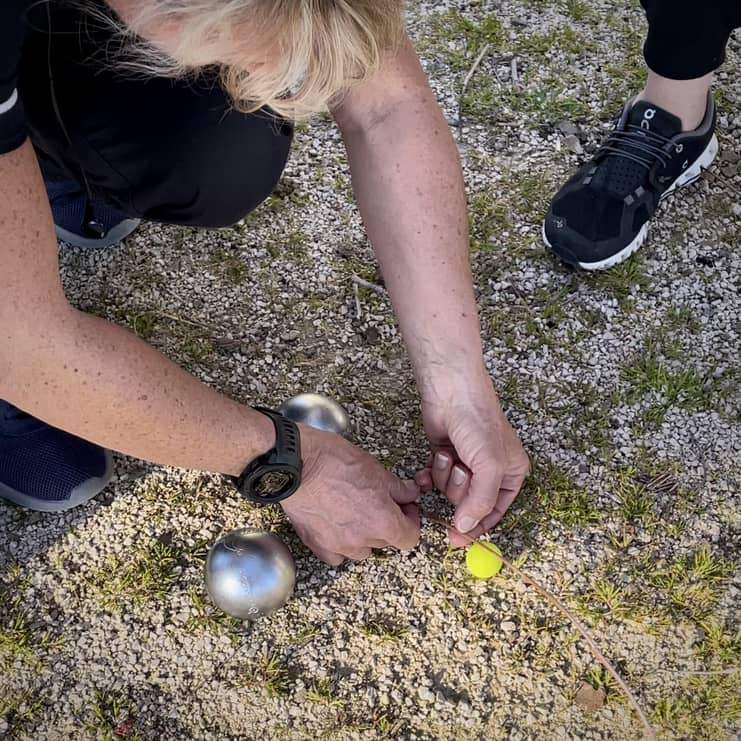
After Dole, our next stop was Saint-Jean-de-Losne. It was a sunny afternoon, and Timi suggested we step ashore to play a few rounds of pétanque. The guys were pitted against the gals. After several rounds the score was 6–6. On the final bowl, both teams landed so close to the target that we had to measure. The gals won by only a few centimeters. Hats off to the ladies.

FullSizeRender2 compressed 1
The winning bowl was close enough to measure — pétanque in Saint-Jean-de-Losne. © 2023 Ralph Grizzle

While we played, chef Armand prepared meats and sausages on the deck with baked potatoes and salads. Waiter Oliver poured a light rosé from Provence as we dined outside on the front deck. I could not have imagined a better evening as the sun sank into the Saône.

FullSizeRender6 compressed 1
Side-by-side in Saint-Jean-de-Losne. © 2023 Ralph Grizzle

Armand’s creations have been another highlight of the trip. Dining on CroisiEurope is always top notch, but the chefs on the barges take it to another level. His Baba Rum was a big hit — though a raspberry cake he prepared a few days later was an even bigger one.

FullSizeRender4 compressed 1
Baba Rum cake. © 2023 Ralph Grizzle

What a wonderful life on the Burgundy Canal

FullSizeRender compressed 5
Château de Longecourt. © 2023 Ralph Grizzle

As I end today’s post, Daniele has traveled only about 18 kilometers from Quai Nicolas Rolin, where we started this morning at 9 a.m. I spent the day writing and riding alongside the canal. One stop by bike was the beautiful Château de Longecourt, first built in 1475 on the ruins of an old fortress and redesigned in the 17th century by architect Nicolas Lenoir.

FullSizeRender3 compressed 1
A tight squeeze on the Burgundy Canal as CroisiEurope’s Daniele passes French Country Waterways’ Adrienne. The round balls in the trees are mistletoe — beautiful in a Dr. Seuss sort of way, though the plant is a parasite slowly killing the trees. © 2023 Ralph Grizzle

Before dinner on the first night of our trip, chef Armand serenaded us and said we would need to sing for him to earn our lunch. We did so today — everyone accompanying Louis Armstrong’s What a Wonderful Life, streaming from my iPad. It was a beautiful moment, and one person said that Armand appeared to wipe tears from his eyes. Though the world may have its troubles, it is indeed a wonderful life — made even more wonderful on Daniele as we barge through Burgundy.

P.S. I used to publish photos of fellow passengers and crew. I refrain from that as much as possible now out of respect for their privacy. People, however, make the journey — and never more so than on this trip. From guests to crew, all have been wonderful.

Share on