
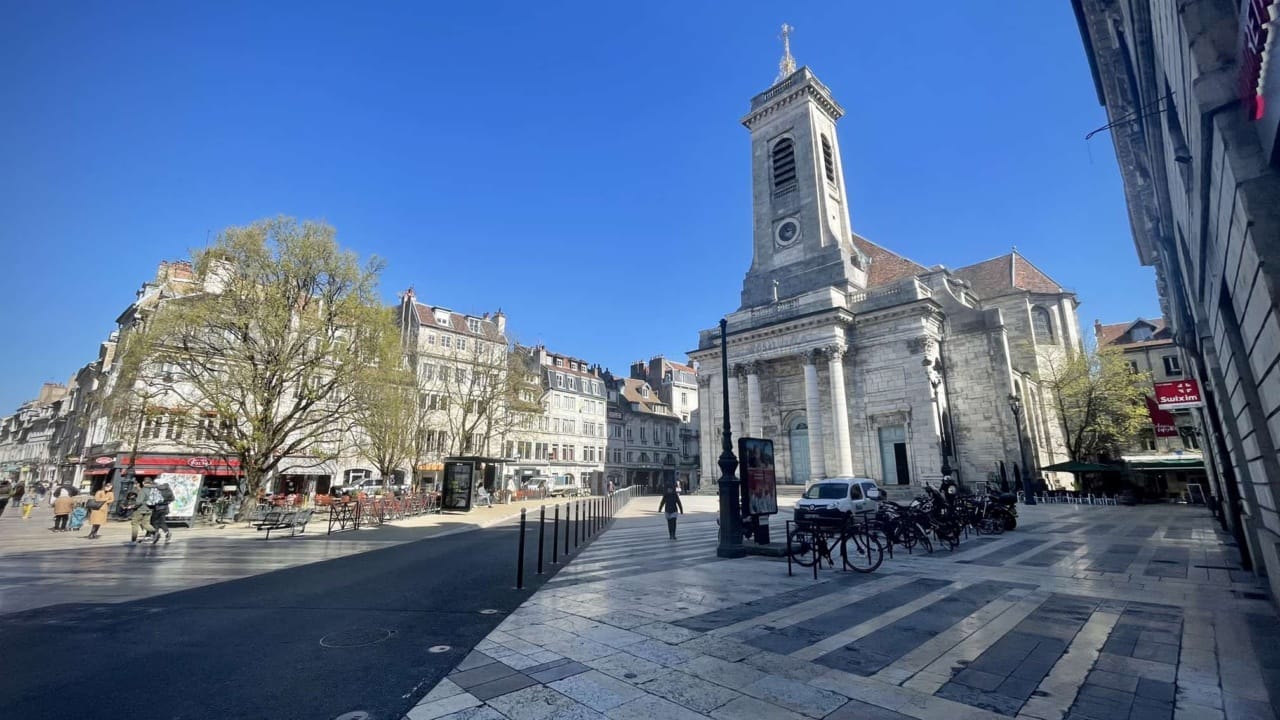
Besançon doesn’t announce itself. There are no billboards on the autoroute, no airport named for the city, no crush of tour buses idling outside a famous landmark. We arrived by fast train from Paris, two and a half hours through countryside that grew quieter and greener the farther east we traveled, punctuated only by Dijon.
We taxied from Besançon Viotte up to Hôtel Le Sauvage, perched high above the city on the hill near the Citadelle. Its setting felt removed from the bustle below, with narrow streets, old stone walls, and a quiet, elevated calm that made Besançon seem to unfold beneath us rather than around us.
Walking the streets after checking in, Besançon seemed almost eerily quiet. This was a university town, yet at 9 p.m. we encountered very few people. After Paris, it felt subdued, almost sleepy. But I had been here before and knew better than to judge it too quickly. By day the city came to life, and by the following evening it had found its rhythm.
Besançon is tucked into a tight horseshoe bend of the Doubs River, as if it has been waiting there, unhurried, for a very long time. Which, as it turns out, it has.
Our group is staying at Hôtel Le Sauvage, and the name turns out to be the only wild thing about it. The hotel occupies what was once a convent of Poor Clares and later a 19th-century mansion, those layers of history still legible in its stone walls and quiet corridors. It sits at the foot of the Citadelle in Besançon’s historic district, just an easy walk from Vauban’s fortress, with views over a wooded park and, beyond it, the medieval ramparts and the Doubs Valley.
Vauban himself, according to local lore, once stayed at the old Sauvage inn that preceded the current hotel. Whether that is history or marketing, it sets the right tone.
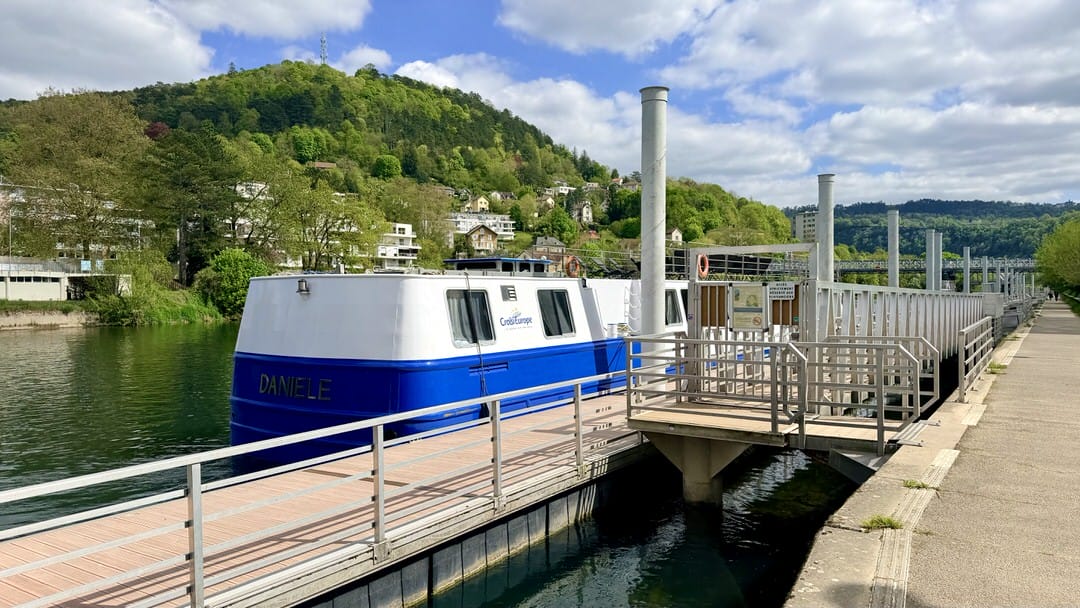
We had two days before boarding the Danielle, CroisiEurope’s 22-passenger hotel barge, and Besançon is the right city for two unhurried days. It is not widely known outside France, which is partly what makes it so appealing. It has a university, which gives it energy. It has centuries of watchmaking heritage — Besançon was once the watchmaking capital of France, a fact the excellent Musée du Temps chronicles in the nearby Palais Granvelle — which gives it a certain precision and pride. And it has a lovely old town, with the Grande Rue forming a pedestrian spine through a grid of merchants’ mansions and quiet squares.
The setting is both defensive and beautiful. From the top of the Citadelle — Vauban’s 17th-century fortress, now a UNESCO World Heritage Site — the view over the looping river is one of the finest in eastern France.
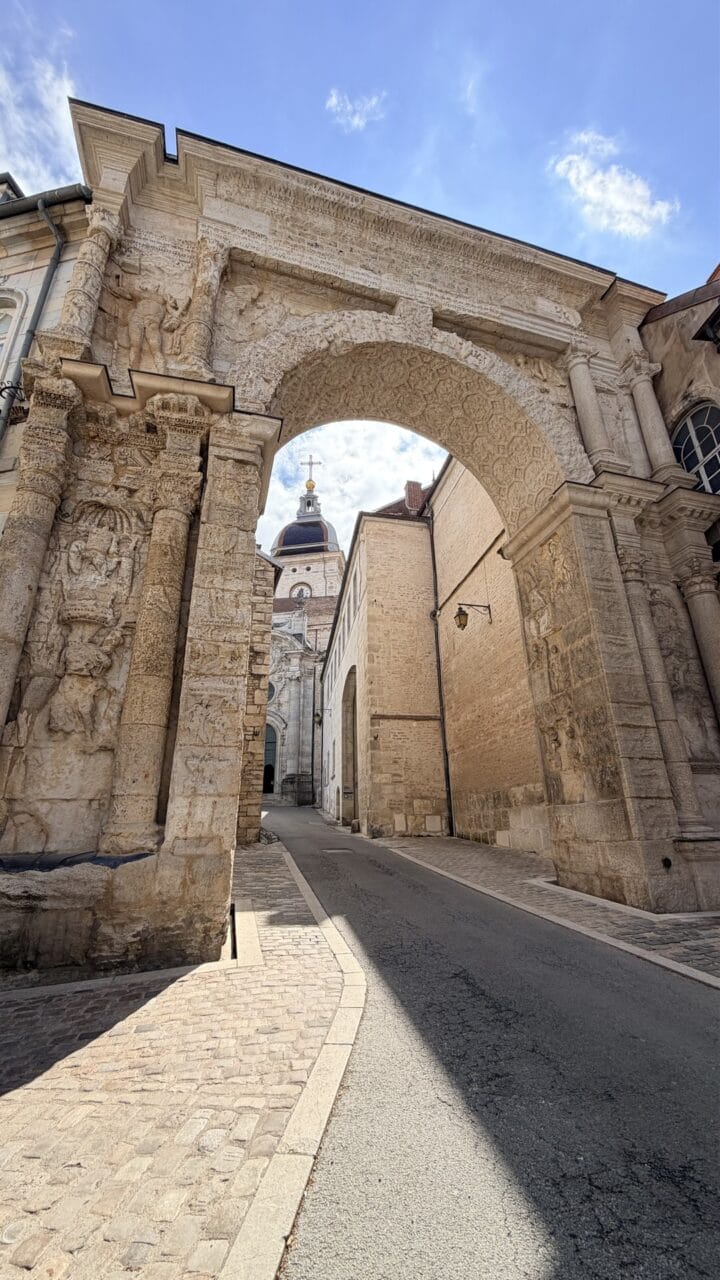
And then there is the Doubs. The river loops around the city in a near-perfect horseshoe, and walking its banks is the best way to understand why people have been living here since Roman times. Back then the city was known as Vesontio, a strategically placed settlement nearly encircled by the Doubs, important enough to draw the notice of Julius Caesar and substantial enough to leave behind monuments that still shape the city today. Walking through Besançon, we felt that layered continuity. The Porte Noire, built in the second century as a triumphal arch, still stands not apart from the city but within it, folded into its streets and stone. Here, Roman history does not feel remote. It feels built in.
Along the Promenade de l’Helvétie, on the banks of the Doubs, a bronze statue commemorates a man most river cruisers have never heard of: Claude-François-Dorothée, Marquis de Jouffroy d’Abbans. Besançon’s tourism office describes the work as a patinated bronze by Pascal Coupot, installed on the Battant Bridge in direct confrontation with passersby. Jouffroy d’Abbans is closely associated with some of the earliest steamboat experiments in France. Local Doubs tourism sources place his first attempts at steam navigation in the Baume-les-Dames area between 1776 and 1778, while Britannica notes unsuccessful trials on the Doubs in 1778 and his later success on the Saône near Lyon in 1783 with the Pyroscaphe, which it calls the first really successful steamboat. So the strongest wording is not that he “made it all possible,” but that Besançon honors one of the earliest pioneers of steam navigation — a fitting figure to encounter before beginning a journey by barge.

See my story about d’Abbans: Where River Cruising Began: A ‘Fire Boat’ On The Saône
At 5 p.m., we board the Danielle. The barge is moored at the quay: 22 passengers, six crew, and a week through the Doubs Valley and Burgundy ahead of us. Besançon recedes as we push west toward Ranchot, Dole, Saint-Jean-de-Losne, and eventually Dijon. But I carry the city with me: the stone walls of Le Sauvage, the looping river, the forgotten inventor along his promenade.
Learn more about upcoming trips: 2026 Alsace | 2027 Paris in the Middle: One Week Or Two, Plus Reims At The End


