

River cruising in Asia is a fundamentally different animal from its European counterpart. Forget the carefully manicured riverbanks of the Rhine or the Danube. In Asia, the rivers are wilder, the landscapes more raw, and the cultural immersion more intense. Two rivers define the river cruise experience on the continent outside of China: the Mekong in Southeast Asia, and the Ganges in India. They have almost nothing in common except the fact that both will leave you changed.
(For river cruising in China, including the Yangtze, [see our separate guide here].)
The Mekong: Vietnam, Cambodia, and Beyond
The Mekong is one of the great rivers of the world, originating in the Tibetan highlands and winding nearly 3,000 miles through China, Myanmar, Laos, Thailand, Cambodia, and Vietnam before emptying into the South China Sea. For river cruise purposes, the action centers on the lower portion of the river — the stretch running between Ho Chi Minh City (Saigon) in southern Vietnam and Siem Reap in Cambodia, a journey of roughly eight days by ship depending on direction of travel.
Most mainstream cruise lines — Viking, AmaWaterways, Avalon, Scenic, Emerald, and others — operate this Vietnam-Cambodia corridor, with itineraries that can run upstream or downstream. The ships are smaller than their European counterparts, typically carrying between 28 and 84 guests, which contributes to the more intimate, expedition-like feel of the experience.
Key ports and what happens there:
Ho Chi Minh City (Saigon) serves as one terminus for most itineraries. It’s a sprawling, kinetic city where French colonial architecture rubs shoulders with modern glass towers and chaotic street life. Cruise lines typically include a city orientation and visits to historically significant sites — the Cu Chi Tunnels, the intricate underground network used during the Vietnam War, are a popular and sobering excursion. Evening Vespa food tours through the city’s back alleys have become a signature offering among the more experiential cruise lines.
Sailing up the Mekong Delta, ships stop at a succession of smaller towns and villages where daily life unfolds on and around the river. Cai Be is known for its floating market, where vendors sell produce from their boats at dawn in the traditional manner. Sa Dec, a quiet provincial town, rewards visitors with French colonial architecture and fragrant flower nurseries lining the riverbanks. Chau Doc, near the Cambodian border, offers visits to a Cham Muslim community — a reminder of the remarkable ethnic and religious diversity of the region — as well as a mountain pagoda perched above the town with panoramic views across the delta.
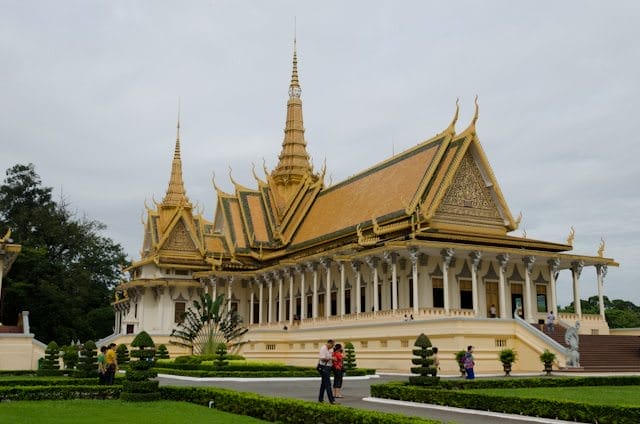
Crossing into Cambodia, Phnom Penh, the capital, is an essential and emotionally complex stop. The Royal Palace and Silver Pagoda represent the country’s centuries-long royal tradition, while a visit to Tuol Sleng Genocide Museum — the former Khmer Rouge prison — confronts visitors with the country’s more recent and devastating history. Cruise lines handle this combination of beauty and tragedy with care, but passengers should be prepared for the emotional weight of a Phnom Penh day.
The centerpiece of most Mekong itineraries is Siem Reap, which serves as the other terminus and is home to the Angkor Archaeological Park — one of the most significant archaeological complexes in the world. Angkor Wat, the 12th-century temple built as a dedication to the Hindu god Vishnu and later converted to a Buddhist site, is the largest religious monument on earth and genuinely lives up to its reputation. Most cruise lines include a full-day excursion covering Angkor Wat, the face-tower temple of Bayon, and the jungle-embraced ruins of Ta Prohm, where the encroaching roots of enormous trees have grown through the stonework in one of the most visually striking tableaux in all of Asia.
Some itineraries also incorporate a Laos extension, stopping at Luang Prabang — a beautifully preserved UNESCO-listed city of temples, French colonial buildings, and monks in saffron robes conducting their pre-dawn alms-giving procession along the main street.
A practical note on the Mekong: Water levels vary seasonally, which can affect itineraries and even whether certain stretches of the river are navigable. The dry season from November through April is generally considered the best time to travel, though the wet season brings lush green landscapes and its own appeal.
The Ganges: India’s Sacred River
The Ganges is not a cruise destination in the conventional sense. It is a pilgrimage. For hundreds of millions of Hindus, the Ganga — as it is known in Sanskrit — is a goddess, a sacred entity whose waters carry the power of spiritual purification. Cruising it is an act of immense privilege and, if you approach it with the right frame of mind, one of the most profound travel experiences on earth.
The river cruise landscape on the Ganges is more specialized and niche than the Mekong. The primary operators include Assam Bengal Navigation (ABN), Antara Cruises, and the Indian government’s own vessel, the Ganga Vilas — which, at roughly 3,200 kilometers from Varanasi to Dibrugarh, operates the longest river cruise in the world. For most Western cruise travelers, the more accessible options are the multi-night itineraries running between Kolkata and Varanasi, often broken into upper and lower Ganges segments.
Kolkata anchors the lower Ganges itineraries. India’s former colonial capital is a city of extraordinary cultural density — the ghats along the Hooghly River (a distributary of the Ganges) are alive with activity, the Howrah Bridge looms over the famous flower market below it, and the city’s intellectual and artistic heritage is palpable in a way that few Indian cities match. Shore excursions here typically include the waterfront flower market, the ornate Pareshnath Jain Temple, and the atmospheric neighborhood of Kumortuli, where artisans craft clay statues of Hindu deities by hand.
Sailing upriver from Kolkata, itineraries pass through the remarkable layered history of Bengal — stopping at Murshidabad, the former seat of the Nawabs of Bengal, where the immense Hazarduari Palace commands the waterfront. Small villages along the way reveal traditional brass-making, terracotta temple architecture, and a way of life that has changed little in centuries. The battlefield of Plassey, where Robert Clive effectively secured British dominance over the Indian subcontinent in 1757, lies along this stretch — a quiet, unremarkable field today that carries enormous historical weight.
Varanasi is the goal — the destination that gives the Ganges cruise its purpose. Varanasi is widely considered the oldest continuously inhabited city in the world, a place of such deep spiritual gravity that Hindus believe dying here brings liberation from the cycle of rebirth. The ghats — the stone steps descending to the river’s edge — are the beating heart of the city, alive at all hours with bathers, priests, pilgrims, cremation ceremonies, and vendors. The nightly Ganga Aarticeremony, in which priests offer fire, incense, and devotion to the river goddess in an elaborate ritual of synchronized movement, is one of the most visually and emotionally overwhelming experiences river cruising has to offer.
A short road transfer from Varanasi brings passengers to Sarnath, where the Buddha gave his first sermon following his enlightenment. The archaeological museum there holds a magnificent collection of Buddhist sculpture, including the original Lion Capital of Ashoka — the symbol that was later adopted as India’s national emblem.
One important consideration: Ganges itineraries are highly seasonal. Access all the way upriver to Varanasi by ship is generally only possible during the high-water season in the summer months; during the rest of the year, some operators end their sailings at Patna and complete the final leg to Varanasi by road or rail. Confirm the specifics of any itinerary carefully before booking.
Mekong vs. Ganges: Which Is Right for You?
The Mekong is the more accessible of the two — a well-established, polished cruise product with modern ships, multiple operator options, and excursions calibrated for international travelers. The Ganges is rawer, more challenging logistically, and demands more of the traveler emotionally and culturally — but rewards that engagement in equal measure.
Both rivers offer something European river cruising simply cannot: the feeling that the world outside your ship window is genuinely ancient, living on its own terms, and largely indifferent to tourism. That quality is increasingly rare, and worth crossing the world for.
Cruising the Mekong
Running between Cambodia and Vietnam in Southeast Asia is the Mekong River. At 4,350 kilometres (2,703 miles) in length, it is the 12th longest river

Guest Post: Cruising The Mekong On AmaWaterways
This week’s guest review was submitted by Paulette Hannah. She and her husband recently returned from a Mekong cruise with AmaWaterways. Upon her return, Paulette reached out to us eager to share her experience.
Five Mekong Misconceptions
Here are five commonly held misconceptions we’ve received from readers over the years about the Mekong.

