
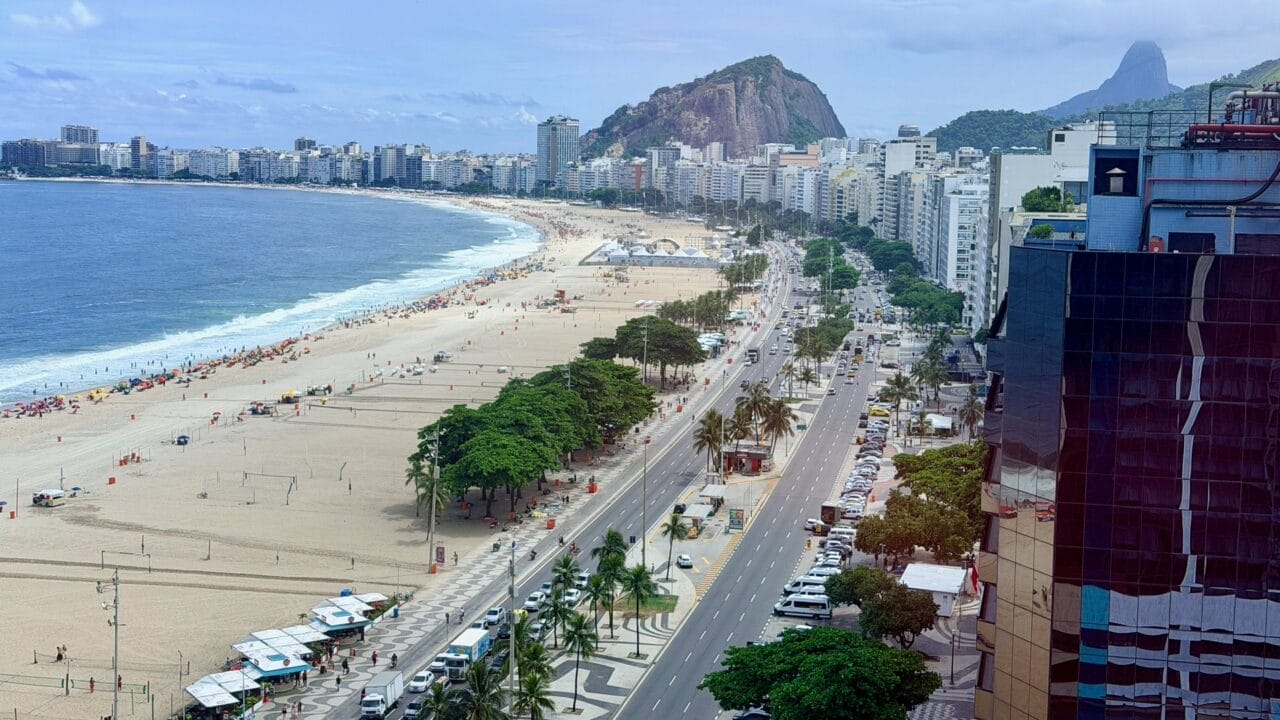
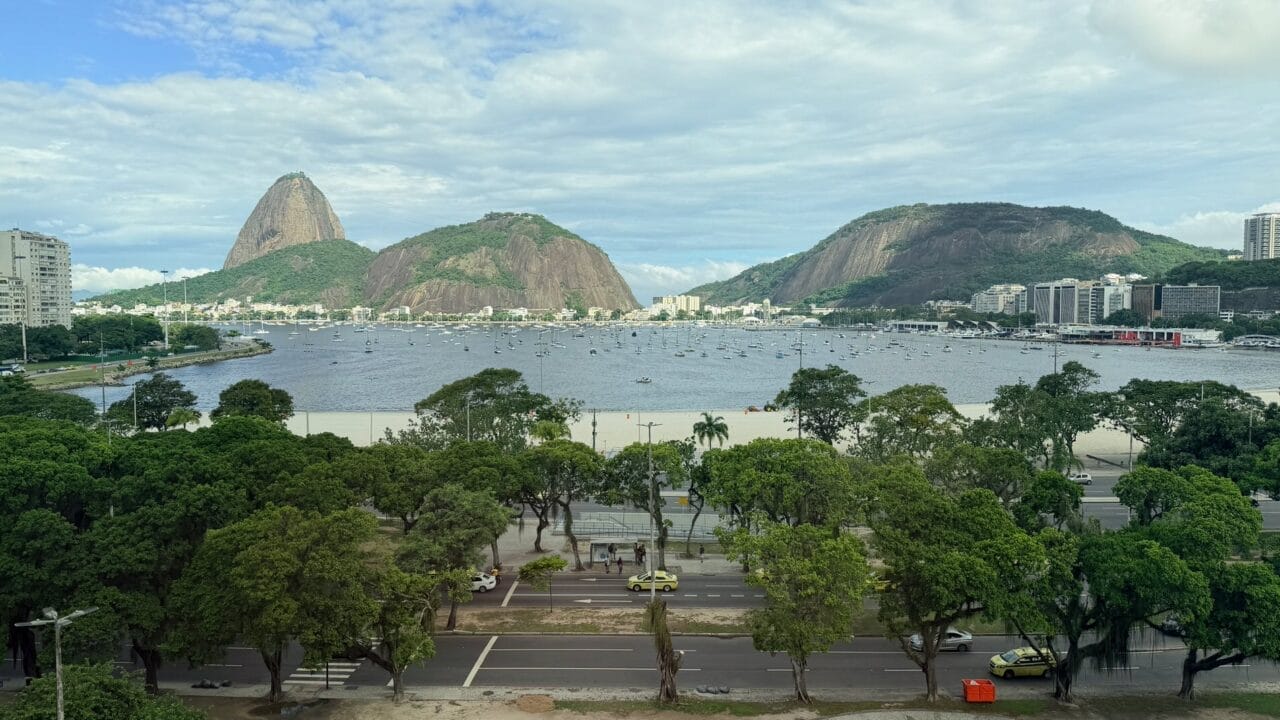
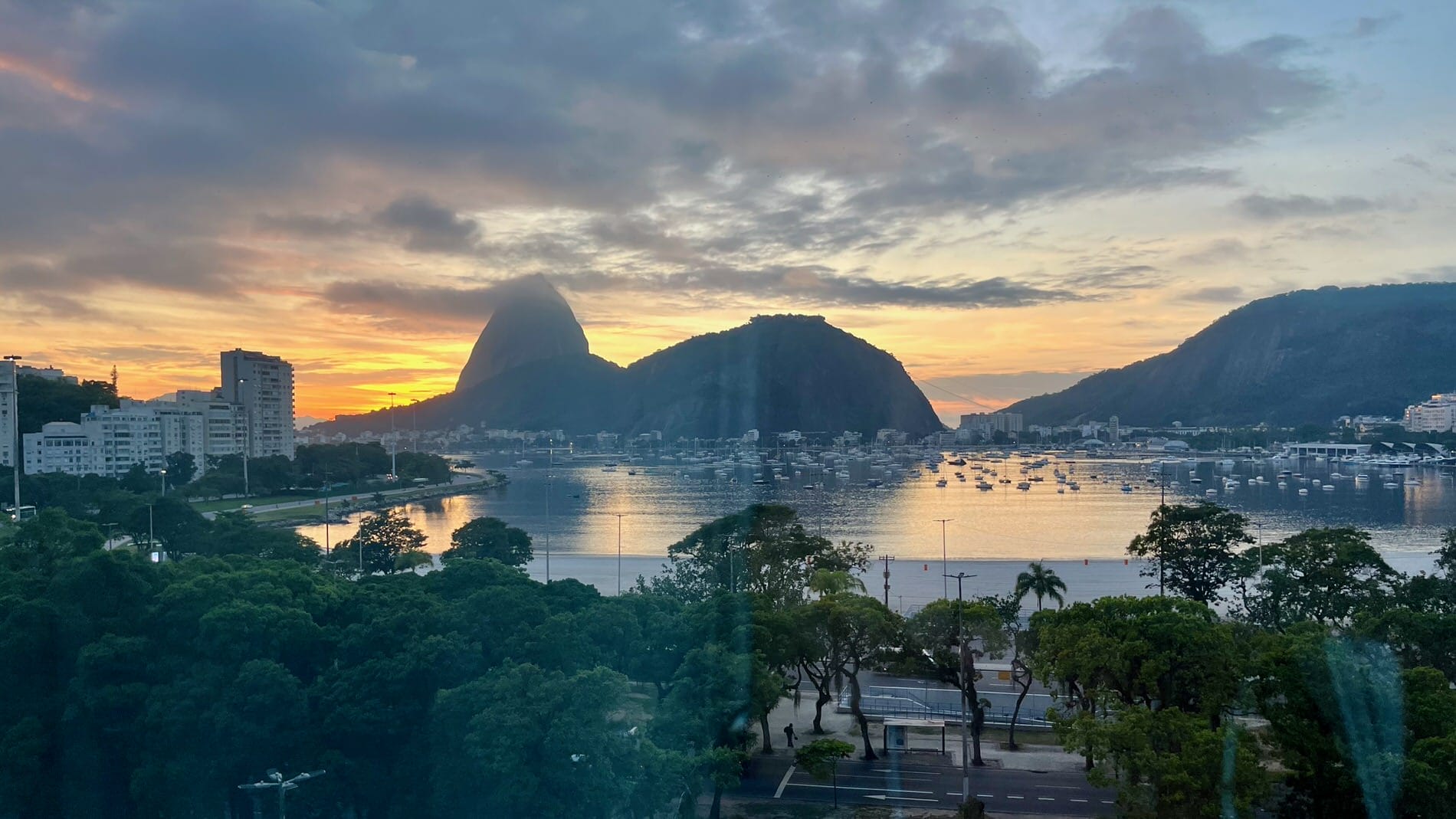
I woke at 6 a.m. on my last day in Rio and gently pulled back the curtains so as not to wake Marucia. There before me was Sugar Loaf, the sun just easing behind it, sailboats resting in the harbor below. From our seventh-floor corner room at the Yoo2 Tapestry hotel, I lingered — the beach still quiet, the city just beginning to stir. It felt like a fitting farewell from a country that had delivered something special every single day.
The beach was coming to life below: joggers and walkers moving along the waterfront, a few people already swimming. I wanted to hold the moment before the day took it.
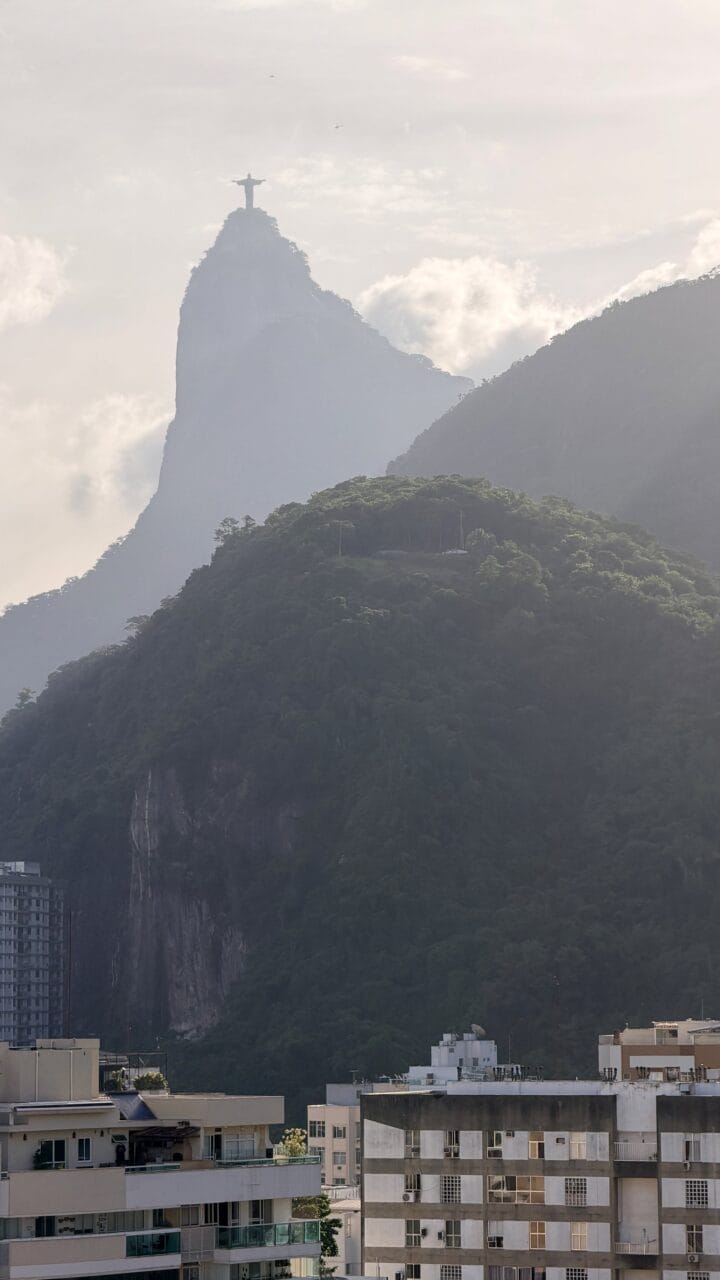
The evening before, from the rooftop bar, Marucia and I watched both Sugar Loaf and the Cristo Redentor statue glow in the fading light — the two great icons of Rio presiding over their city from their high perches, silent and permanent above the noise of it all.
This evening, we fly home. Nearly two months in Brazil, and I find myself sad to go. But I leave knowing I’ll be back.

Why Brazil? Why Now?
This trip was partially for professional reasons. Since 2015, I’ve been hosting small-group barge cruises in France — in Alsace, Burgundy, Provence and other regions — aboard CroisiEurope’s intimate 22-passenger barges that navigate the country’s smaller canals, reaching corners of France that larger river ships cannot access. I’ve hosted more than a dozen of these trips, and the experience has convinced me that small-group river travel — the kind where you know everyone’s name by the first evening and tearful goodbyes are not uncommon on the last morning — is among the finest ways to experience a place.
CroisiEurope has proven to be exactly the right partner for that kind of travel: attentive, well-run and committed to the experience rather than just the itinerary. So when they announced a brand-new 32-passenger ship purpose-built for the Amazon, my thoughts turned to Brazil.
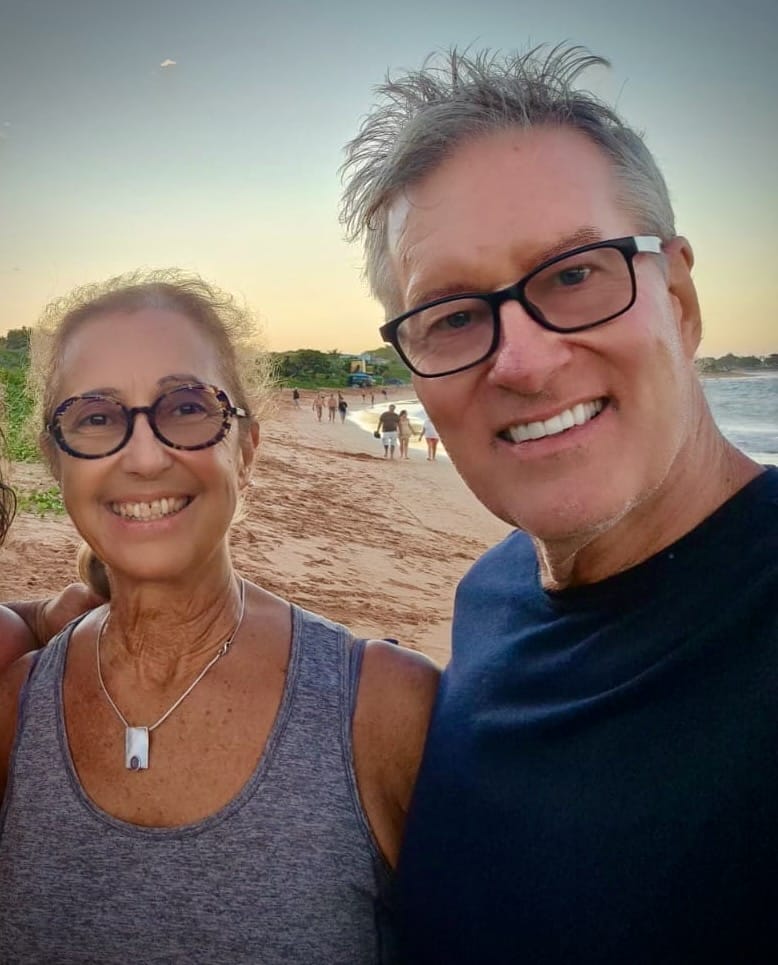
They were already there. Marucia, my companion for this journey, is Brazilian — from Vitória, in Espírito Santo — and though she has lived in California for decades, Brazil is still in her heart. She was the perfect partner for this kind of trip: someone who could open doors that a solo American traveler would never find, introduce me to her family and her beach village and show me a country from the inside rather than the outside. That she also happens to be someone I’ve known for 40 years, fell in love with and only recently found my way back to — well, that’s a story for another time.
The point is that I had both a professional reason to come to Brazil and a personal one, and for once in my life, the two pointed in exactly the same direction. The Amazon was the destination. But Brazil, I suspected, was going to be considerably more than that — and together with Marucia, I was about to find out just how much more.

Manguinhos: The Brazil Most Visitors Never See
On New Year’s Day, we flew into Rio, then north to Vitória — the coastal capital of Espírito Santo state — and from there to our real home for the next six weeks: Manguinhos, a small fishing village about 15 miles up the coast. The house belongs to Rita, Marucia’s sister, who spends summers there with her maid Vania and more dogs than I ever managed to count. But the roots go deeper than that. This is where Marucia and her sisters — Rita and Louisa — spent their summers as girls, the beach just steps from the front door. I was Rita’s guest, but I was also entering something older: the summers Marucia had spent here as a girl.
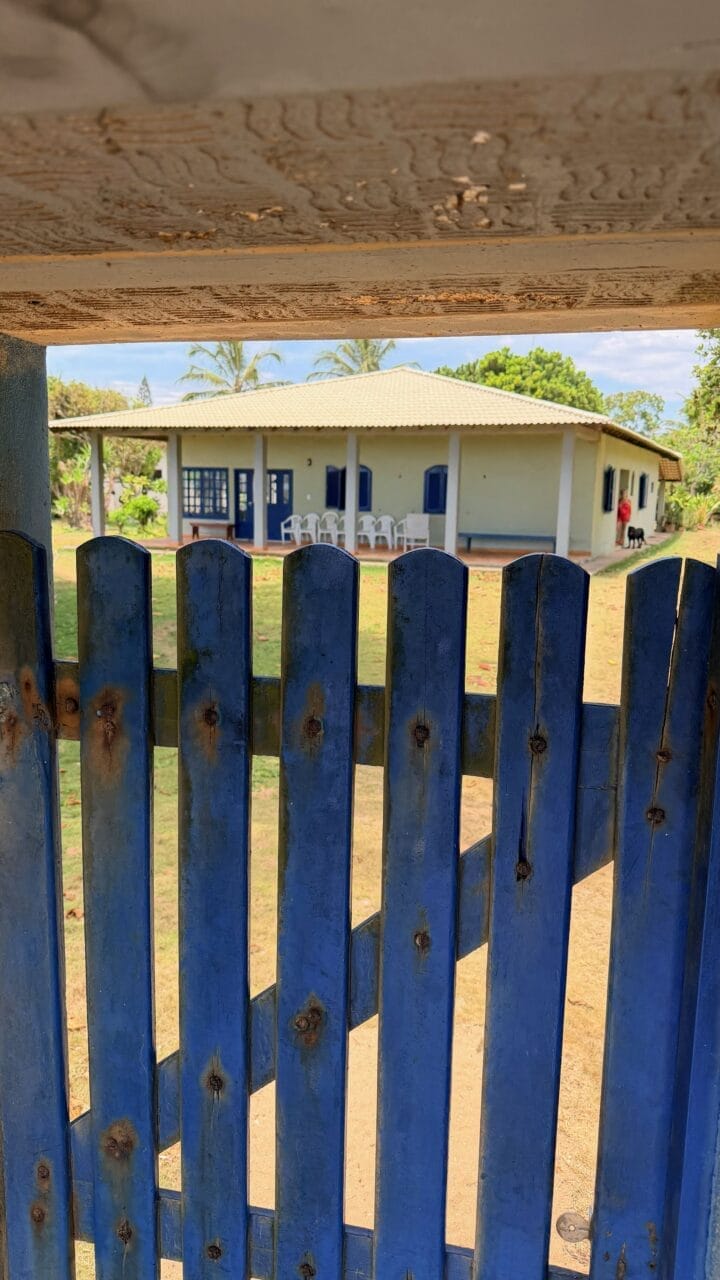
Manguinhos is the kind of place that rewards the traveler who slows down enough to find it. It began as a fishing village around 1900 — among the earliest written references to the coastline here is a passing note by French botanist Auguste de Saint-Hilaire, who passed through Espírito Santo around 1818 and noted a stretch of shore then called Ponta dos Fachos, still a local beach name today.
Electricity didn’t arrive until the 1950s. Even now, Manguinhos retains much of its bucolic, village character — narrow dirt streets, a small central square near the waterfront where fishermen store their boats and a fishing cooperative that still represents the families who have worked these waters for generations.
There is something else that gives Manguinhos a particular resonance for me personally. The main street — Avenida Engenheiro Ceciliano Abel de Almeida — bears the name of Marucia’s grandfather.
“He was an illustrious but hard-working man who came from humble beginnings,” Marucia told me. The inflection point in his life was when a businessman from Rio was looking for a young boy who was good in math to work at his company. Her grandfather went to Rio, eventually leveraging his math skills to attend engineering school.
The more I learned about Marucia’s grandfather, the more remarkable he seemed.
He was an engineer, writer and politician. He was responsible for the construction of the Vitória-Minas Railway, became the first mayor of Vitória in 1909 and later served as the first rector of the Federal University of Espírito Santo. He was one of the most consequential figures in the history of the state.
His connection to Manguinhos was personal as much as professional. He built his summer house (now Rita’s house) on Avenida Atapoã, facing the sea, and over time acquired several parcels of land that he later divided among his daughters. He also drew friends and relatives to Manguinhos, effectively transforming the character of the village.
He purchased more than a million square meters of land from the state of Espírito Santo, on part of which he established the Balneário Atapoã — the first planned residential development in Manguinhos. He even named the main avenue of that development after Auguste de Saint-Hilaire, the French botanist who had noted this stretch of coastline a century earlier — a gesture that suggests a man with a sense of history and place.
Standing in that square, knowing that the village around me was shaped in no small part by Marucia’s family, adds a layer to the experience that no guidebook can provide. This was not just any beach village. For Marucia, it was the place where summers were spent and memories were made. I had a feeling it was about to do the same for me — and it did. Manguinhos could be sleepy at times, but I didn’t mind. The village knew how to come alive when it mattered — on holidays, on weekends and especially during Carnaval.


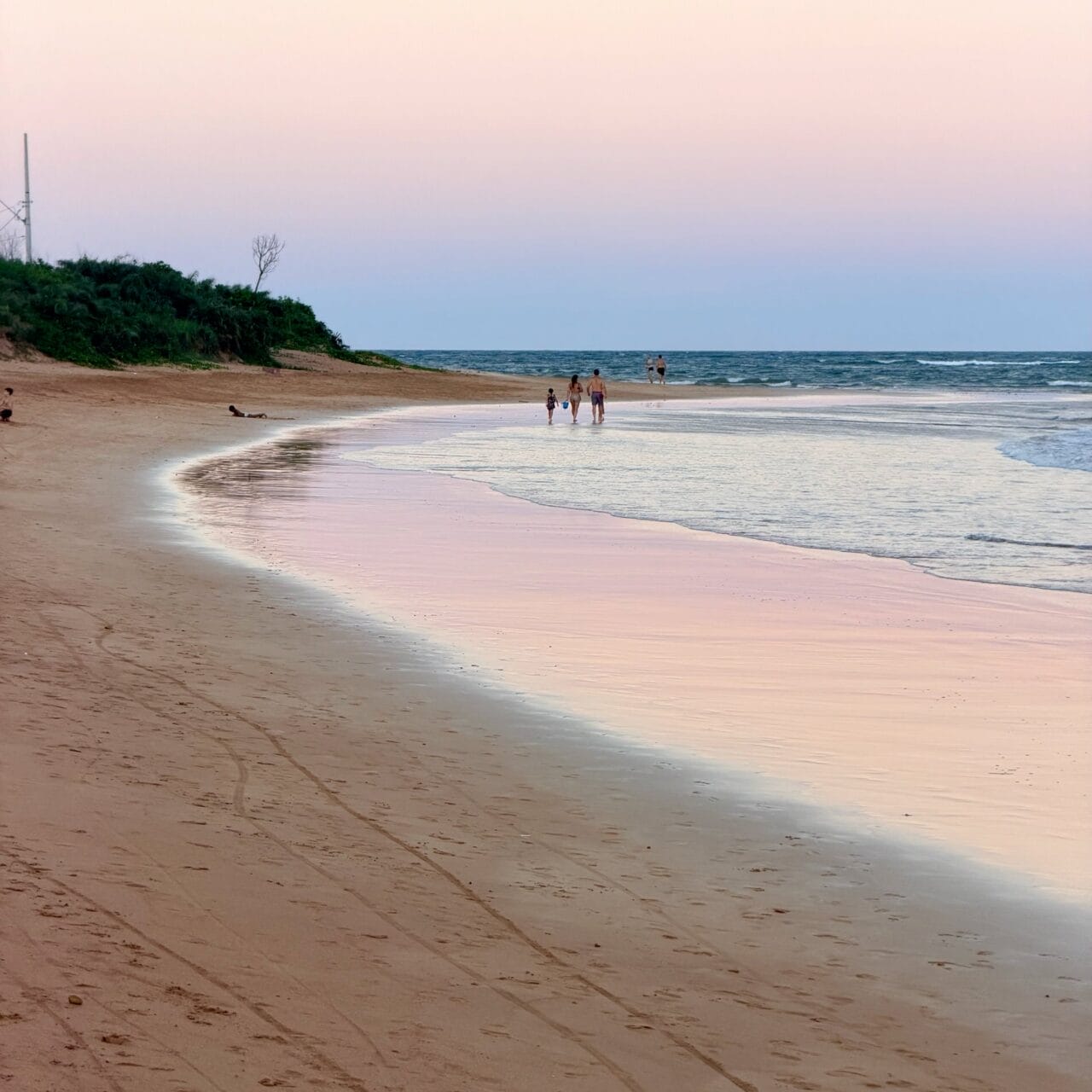
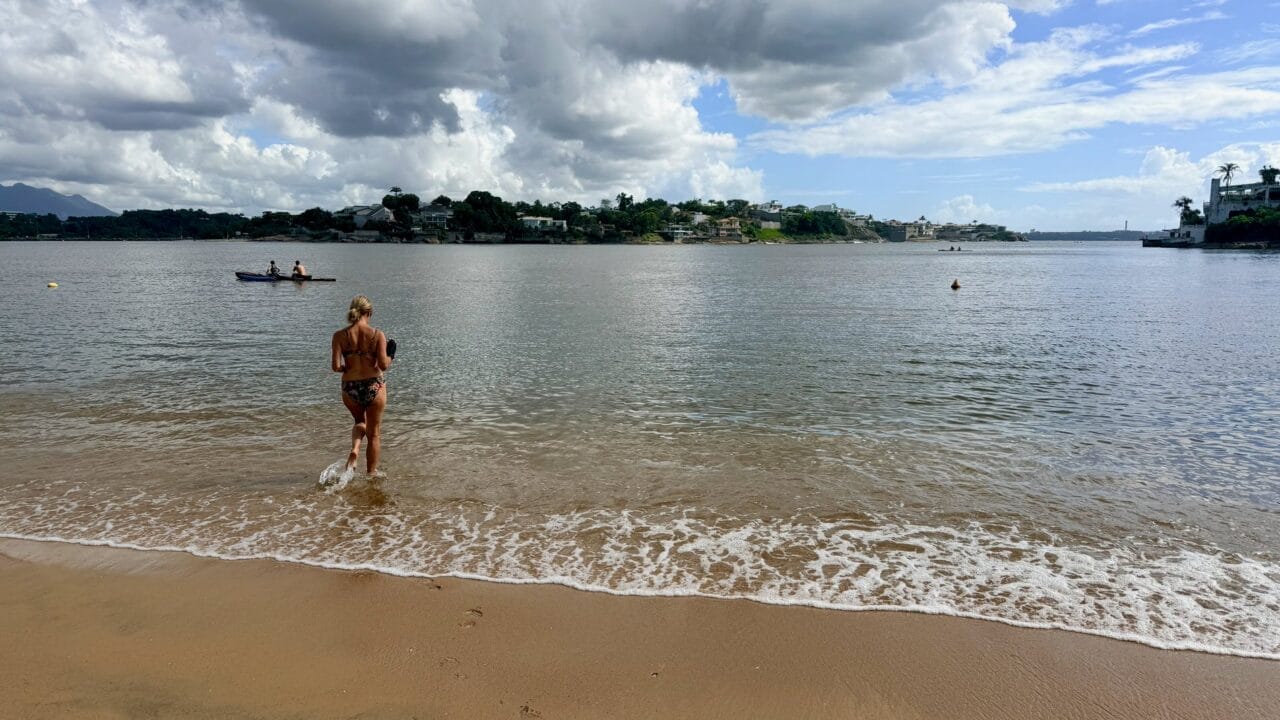
The beach itself is lively and lovely, with cresting waves that carry surfers and swimmers. In summer (January and February, when we were there), it fills with life. The beach economy kicks into gear with an entrepreneurial energy I found genuinely charming — and genuinely delicious.
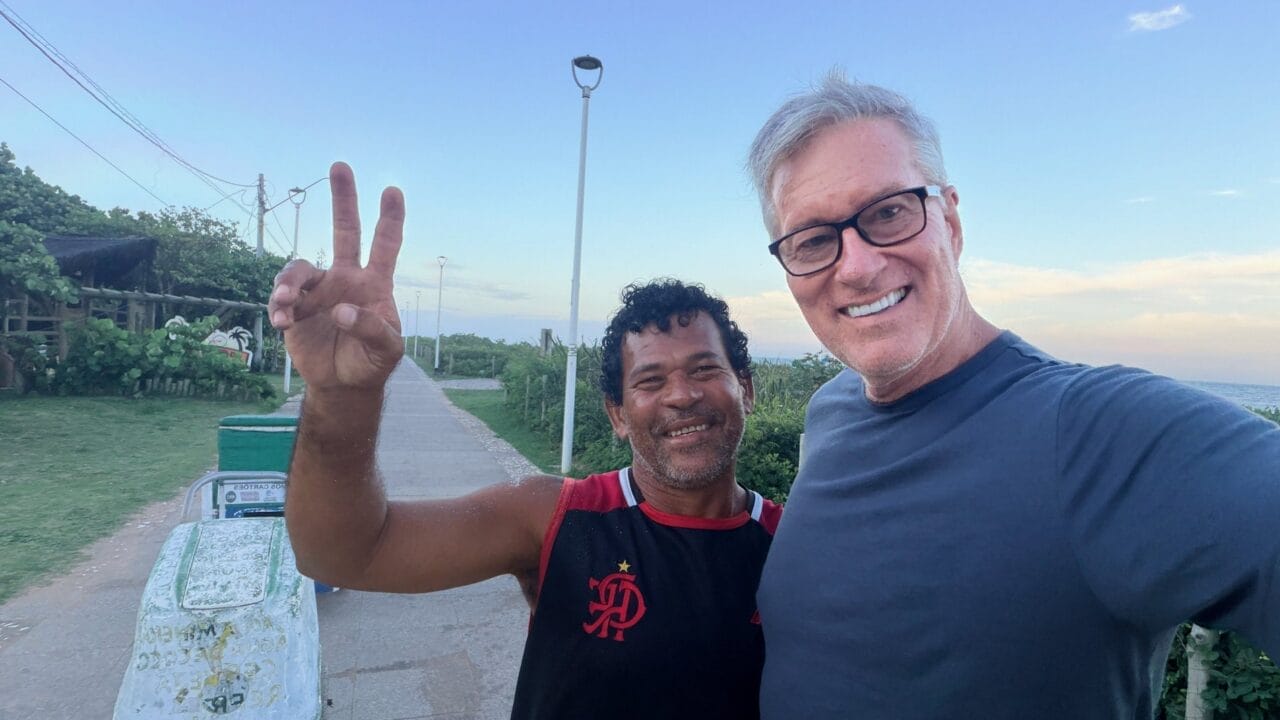
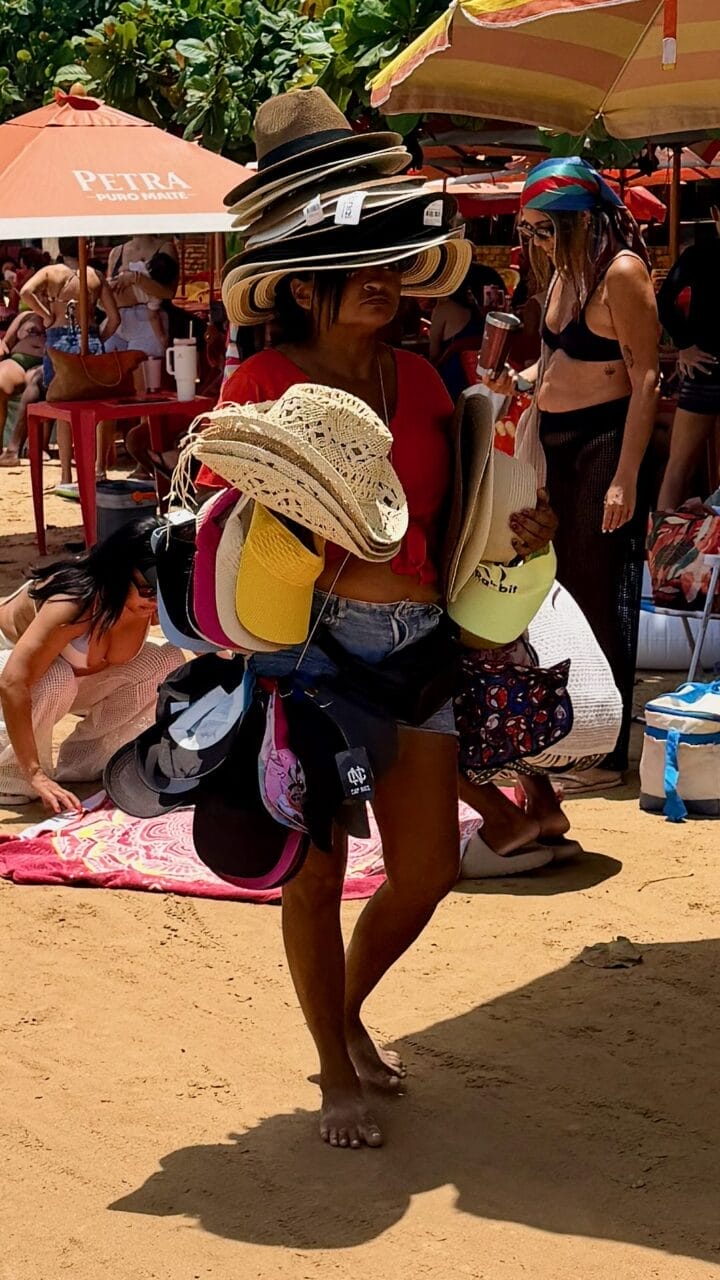
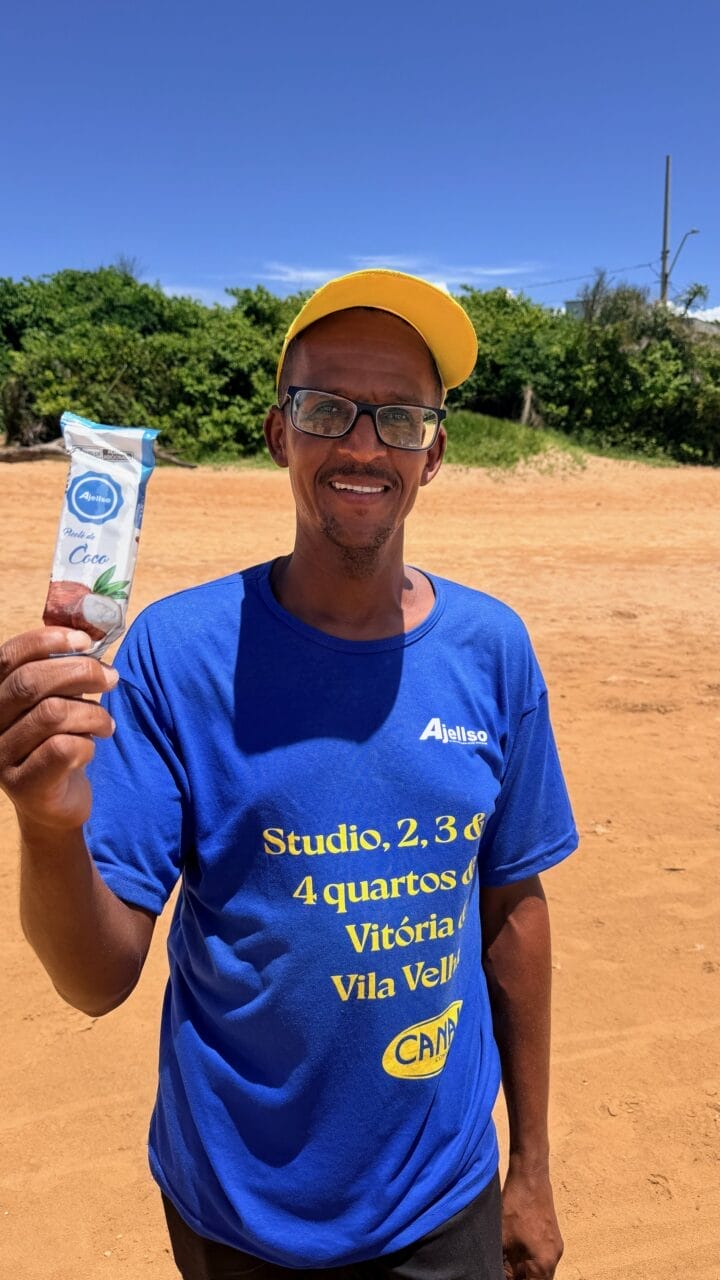
From a covered cart on the beach, Jorge sold fresh coconut water, wielding his machete to open coconuts each day right in front of me. Wedres ran a rolling mini supermercado — a little market on wheels that made its rounds along the sand. Pedro sold milho verde, corn on the cob, boiled and slathered with butter, prepared right there on the beach. Others circulated with picolé (ice pops), sorvete (ice cream) and roasted castanha de caju — cashews, which of course come from Brazil.
Then there was the cheese man. He walked the length of the beach carrying a small charcoal grill on a handle, skewers of queijo coalho (pronounced roughly KAY-zho KWAH-lyo) sizzling as he roasted the cheese.
Queijo coalho is a firm, semi-hard cheese from northeastern Brazil that does something remarkable: it doesn’t melt. Instead it chars and crisps on the outside while staying dense and chewy within, squeaking slightly against the teeth — similar to halloumi.
Grilled over coals with a sprinkle of oregano and eaten on the stick, it is one of those simple beach pleasures that would be difficult to replicate at home.
Another vendor walked the sand with a bucket of live siri — small blue swimming crabs native to the Brazilian coast, distinct from the larger land crab (caranguejo) you find in stews and restaurants. Siri are intensely flavored, sweet and briny, and are eaten here stuffed, fried or simply boiled.

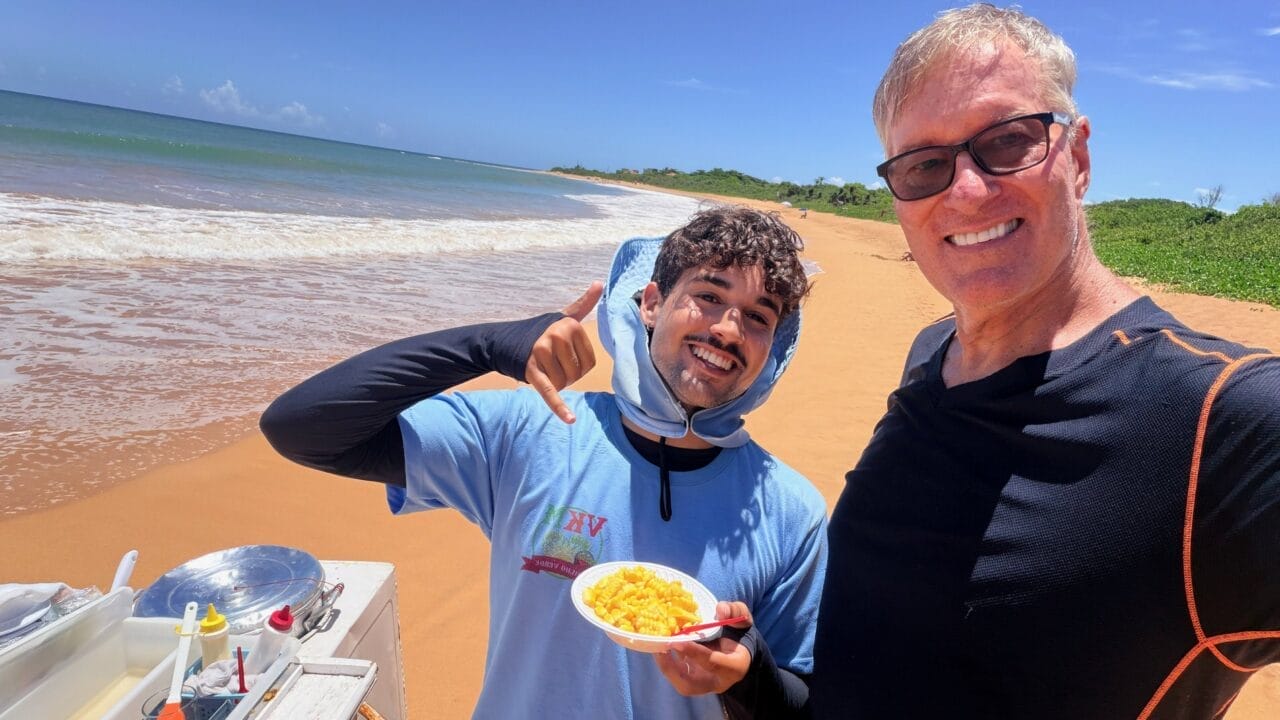
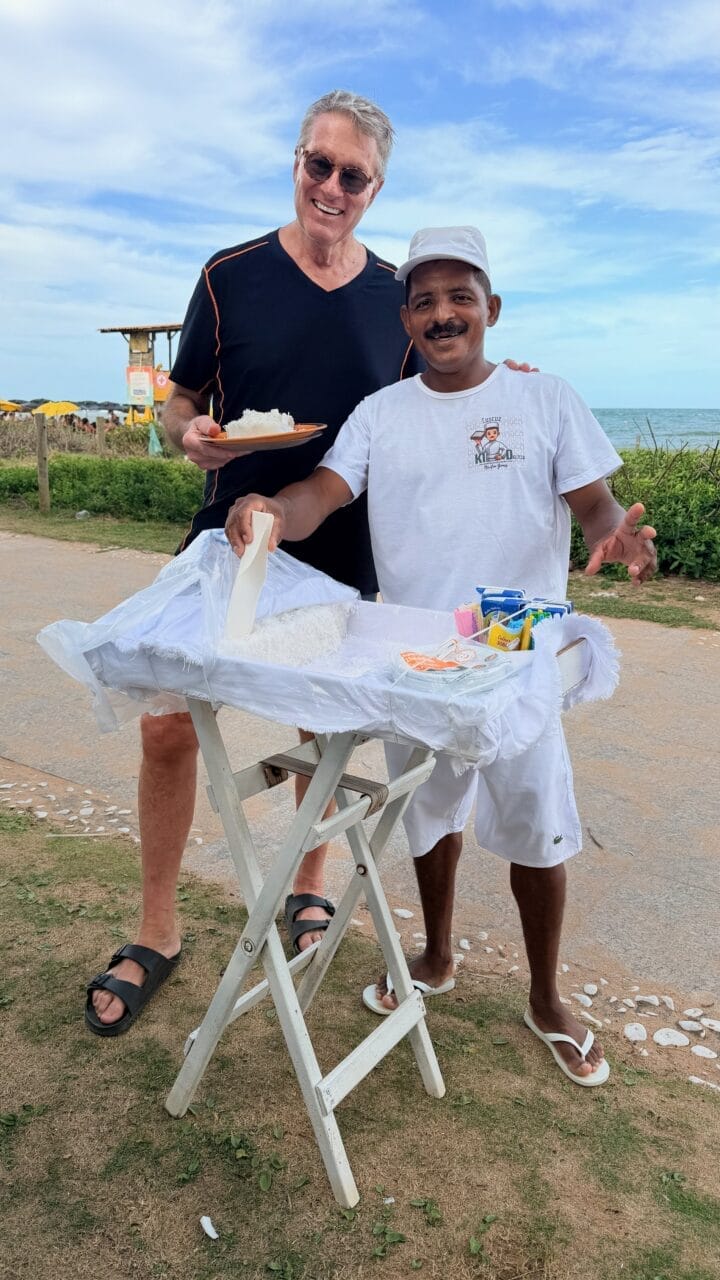
More than once, I was visited by the cuscuz de tapioca vendor, who set up a small folding table right there on the beach and made my dessert to order. Cuscuz de tapioca — the dish you might phonetically call “cus cuz” — is a sweet, flan-like treat made from tapioca pearls (a starch derived from cassava, native to this region long before European colonizers arrived), grated coconut and milk, set until firm and served in squares drizzled with sweetened condensed milk. It is cool, creamy, gently sweet and entirely addictive on a hot afternoon. The roots of the dish trace back to both the indigenous peoples of the Northeast and the ingenuity of African cooks during the colonial era, who discovered that tapioca and coconut made something extraordinary together.
We parked our Havaianas on the sand each morning before wading in. Havaianas are Brazil’s iconic rubber flip-flop — made since 1962, worn by virtually everyone from the beach to the corner store, and now sold in more than 100 countries. They began as a humble sandal for working-class Brazilians (the name comes from the Portuguese word for Hawaiian) and became a genuine cultural institution. The simple flat sole and Y-shaped strap have never changed. In a country with no shortage of style, the Havaianas endure by being exactly what they are.
One thing I hadn’t fully anticipated was how much the language would matter — and how much pleasure there was in trying. Few people in Manguinhos speak English, and my Spanish, while not useless, was a blunt instrument. The vocabulary overlaps enough to be tantalizing, but Brazilian Portuguese has its own music entirely — rounder, more nasal, with sounds that bear little resemblance to what you’d expect from the written word.
I’d been studying on Duolingo for months before we arrived, and I kept at it every day. It was enough to get by, and Brazilians — at least in Manguinhos — were wonderfully patient about it.
More than patient: curious. Brazilians in this part of Espírito Santo are genuinely interested in strangers. Where are you from? What do you think of Brazil? Do you like the food? These were not polite questions — they were real ones, asked by people who wanted to know the answers. That ease of connection is one of the things that makes Brazil so seductive for a traveler. The language barrier is real, but the social barrier barely exists.

As I alluded to earlier, the community has a strong festive calendar. Carnaval in Manguinhos brings a tradition called Banho de Mar à Fantasia — a costumed sea-bathing ritual more than 60 years old, in which elaborate outfits inspired by the village’s fishing heritage parade from the central square to the water’s edge to the sound of samba and regional rhythms. More than 15 blocos (Carnaval groups) participate.
We also witnessed a second festival I hadn’t anticipated — a lively procession in which a boat was drawn from a church through the streets to the drumming and chanting of the crowd. It was as electric as Carnaval.
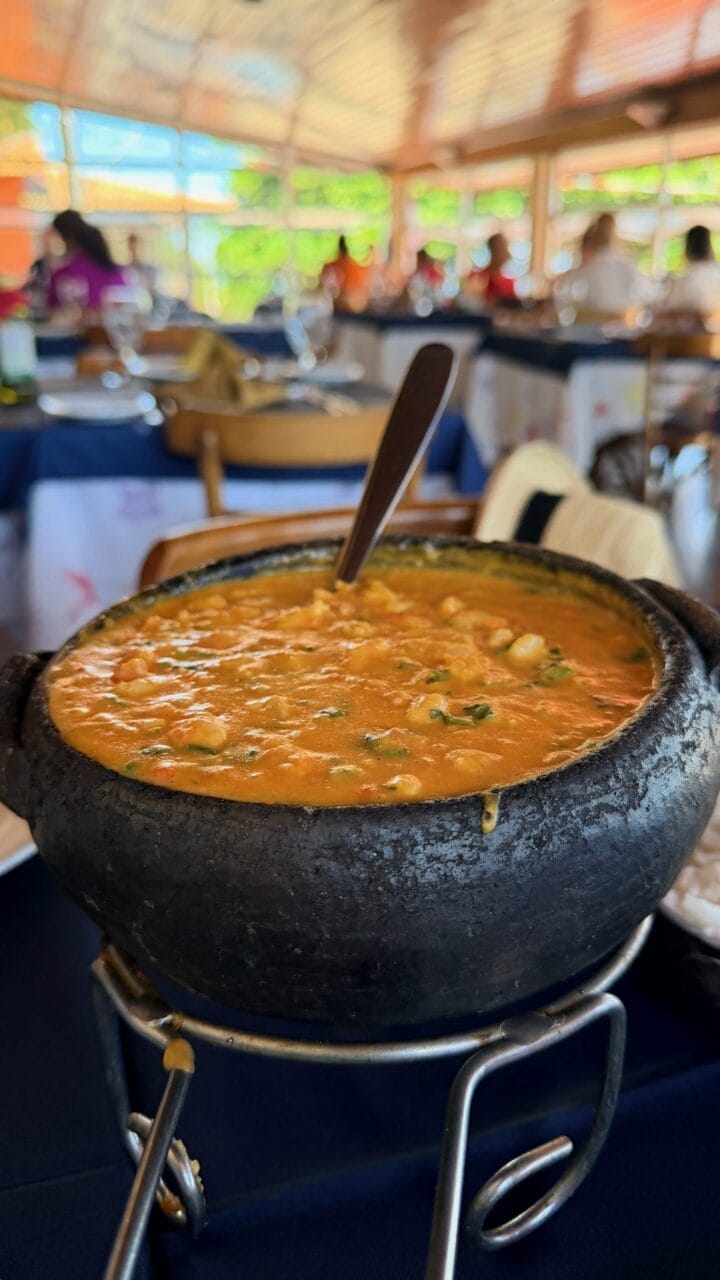
And the food. Espírito Santo has its own culinary identity, distinct from the better-known cuisines of Bahia or São Paulo. The signature dish is moqueca capixaba — a seafood stew that has been simmering in clay pots in this region for centuries.
Unlike its Bahian cousin, which uses rich palm oil and coconut milk, the capixaba version is lighter and more delicate: fresh fish, tomatoes, onions, garlic, coriander and urucum (annatto), the indigenous red seed that gives the broth its warm, golden hue. It is served in the same handmade clay pot it was cooked in, alongside white rice and pirão — a thick, savory porridge made from fish broth and cassava flour.
The clay pots themselves are a cultural artifact, handcrafted by the Paneleiras de Goiabeiras, potters in a Vitória neighborhood whose craft was designated a national cultural heritage site by the Brazilian government in 2002.
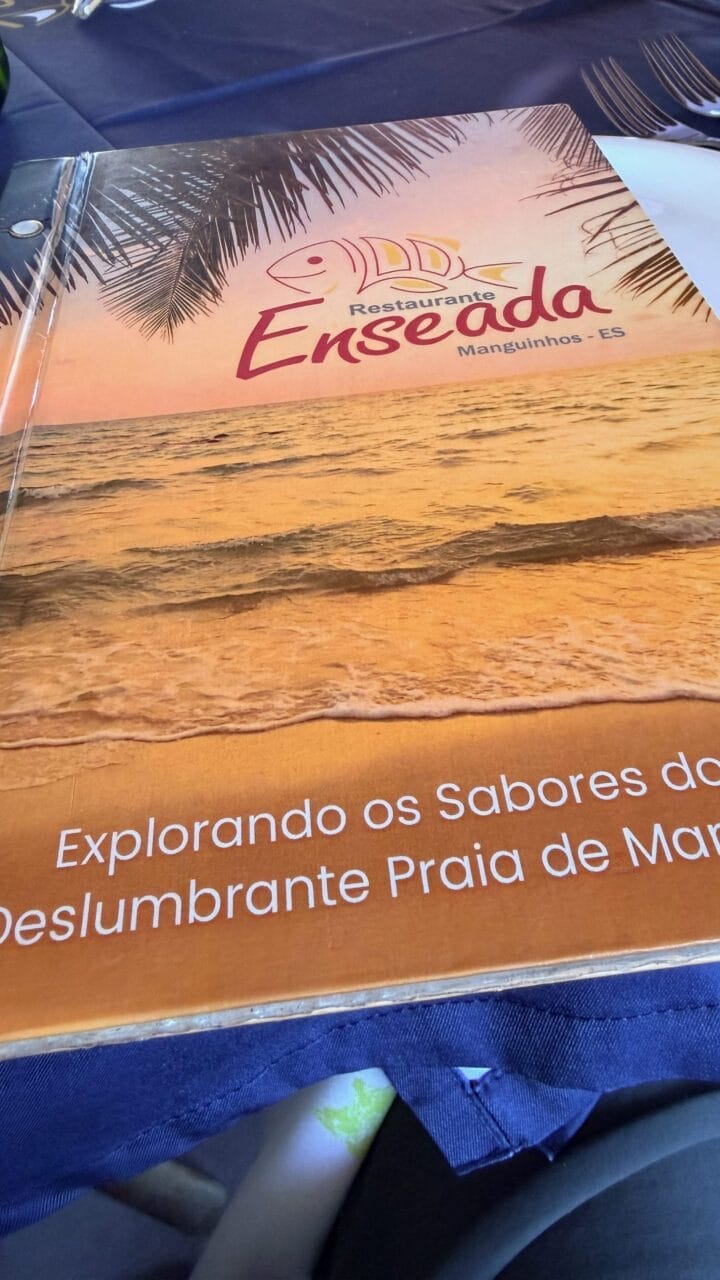
When you sit down to a moqueca capixaba in Manguinhos, at a restaurant like Enseada, you are eating something that connects directly to the indigenous peoples who first cooked fish on this coastline centuries ago.
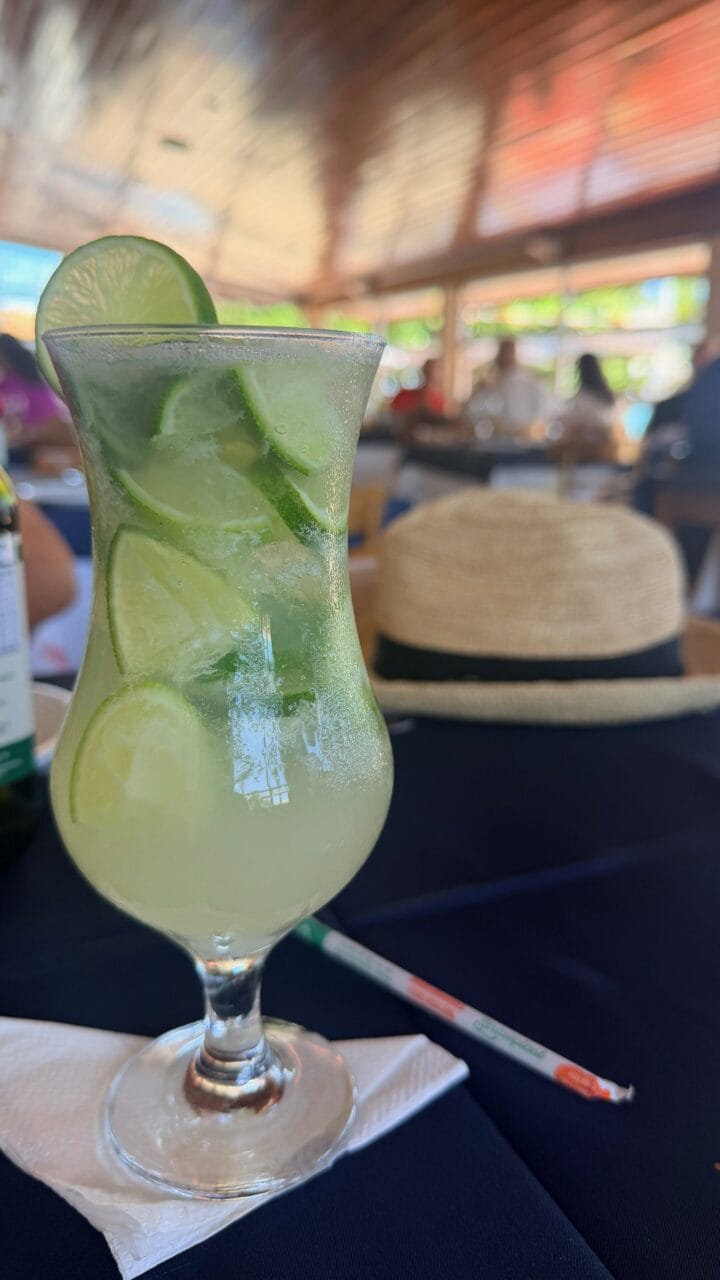
On many evenings, before or during dinner, we enjoyed caipirinhas — Brazil’s national cocktail, and one of the great simple pleasures of the country. The recipe is straightforward: Half a lime cut into wedges and muddled in the glass with a spoonful of sugar, packed with ice, then topped generously with cachaça — a spirit distilled from fermented sugarcane juice that is entirely distinct from rum, despite what you might expect. It tastes of the cane fields: raw, bright, slightly grassy, with a clean burn. The muddled lime and sugar soften it into something wonderfully refreshing on a warm evening. Order one in Brazil and you’ll understand immediately why the country didn’t feel the need to import cocktail culture from elsewhere.
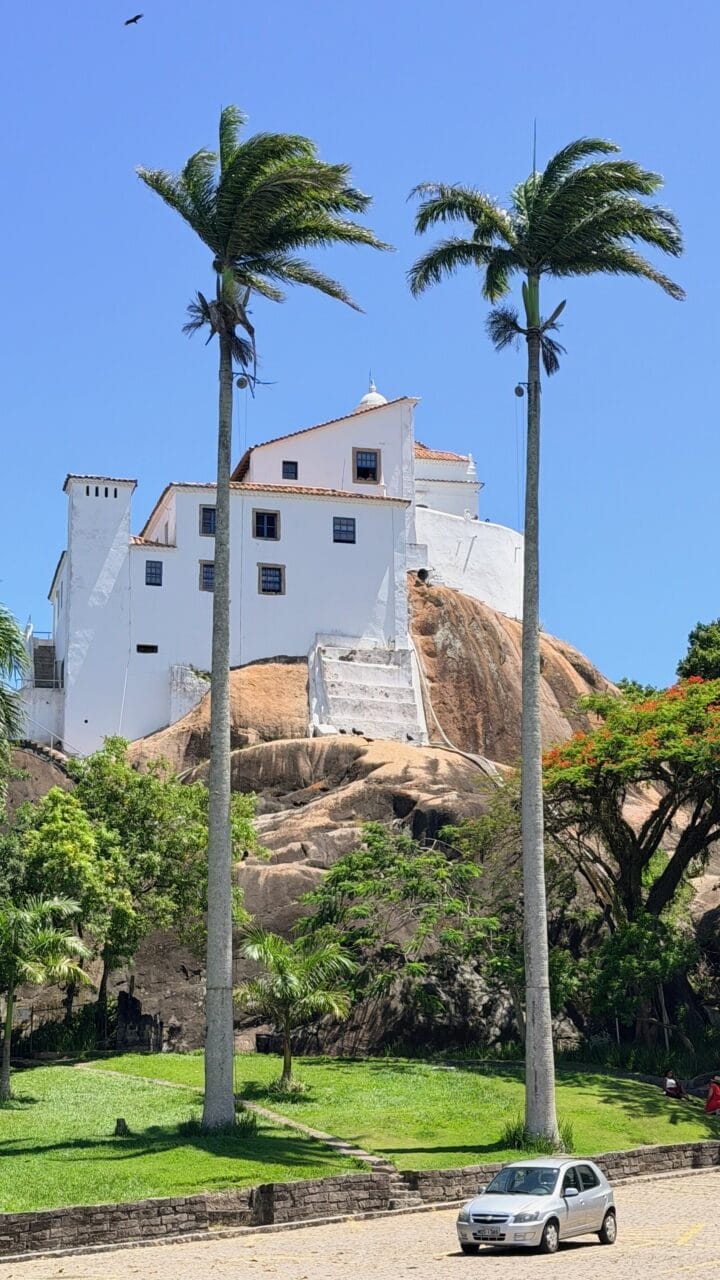
For date nights on Wednesdays, Marucia and I would travel about 45 minutes south to Vitória, where she was born and later baptized in the Convento da Penha — a beautiful hilltop monastery with sweeping views over the city and the bay beyond. We stayed at the Sheraton Vitória on at least five separate occasions (a bank of accumulated hotel points that I put to good use), and each morning Marucia would stand at the window looking out at the beach where she swam as a girl. There is something quietly moving about watching someone look out at the place where they grew up — as if the years fall away and for a moment, the girl who swam on that beach is still completely present in the woman standing at the window.
A Weekend In The Mountains: Domingos Martins & Pedra Azul
One weekend we left the coast and drove inland with friends to Domingos Martins — about an hour from Vitória, up into the mountains — and arrived somewhere that took a moment to make sense of. Half-timbered chalets. Flower gardens bordering a tidy central square. A craft brewery run by a man whose great-great-grandfather came from Prussia. The town was founded in 1847 by Lutheran and Catholic families from the Hunsrück region, and the heritage has not faded so much as deepened — it’s in the architecture, the food, the cadence of daily life.
We happened to arrive during a German festival, and the town had given itself over to it completely. Locals in lederhosen filled the square, oompah bands competed with the noise of the crowd, and log-cutting contests drew enthusiastic spectators. It was Brazil, unmistakably — but a Brazil that had been carrying a piece of Germany for nearly 180 years, and was in no hurry to let it go.

The Lutheran-Evangelical church on the main square, founded in 1866, is considered the first evangelical church in Brazil to have a bell tower — at the time, the Imperial Constitution permitted bell towers only in Catholic churches, making its construction a quiet but consequential act of defiance.
Espírito Santo is also home to the largest community of East Pomeranian speakers in the world, a linguistic remnant of 19th-century immigration that has survived more than 150 years largely intact. Language, it turns out, is more durable than almost anything else a people carries with them.
From Domingos Martins we drove on to Pedra Azul — the Blue Stone — and there is simply no preparing for it. A granite monolith rising nearly 6,000 feet, it dominates the landscape for miles in every direction. But its defining quality isn’t its size. It’s that it refuses to hold a single color.


We arrived before noon, and Pedra Azul was green — a deep, muted green from the lichens and algae coating its surface. It later shifted toward blue. In the evening, I was told, it became almost amber. Pedra Azul is said to change color as many as 36 times in a single day. Brazilians know the name well — it’s also one of the country’s most popular brands of bottled water.
We all marveled at the Blue Stone over cups of hot chocolate at Oca Kau, a bean-to-bar chocolate shop perched in the hills with Pedra Azul filling the window behind us. It seemed like the right way to take it in.
Rio de Janeiro: The Grand Finale
We saved Rio for the final week before flying home, and that turned out to be exactly the right call. After six weeks in the quieter rhythms of Manguinhos and Vitória, arriving in Rio felt like stepping into a film — the volume turned up, the color saturated, the energy physical.
Rio rewards slow travel. Three to four nights is the minimum. Time enough to find your footing in different neighborhoods, take a tram up to Santa Teresa, and stand before the Redeemer when the clouds part and the whole city spreads below.
The Yoo2 Tapestry was a fine base — well-located, with a rooftop bar where Sugar Loaf and the Cristo Redentor appear together at dusk, the city’s two great landmarks sharing the same frame.
On our last morning, as I watched Sugar Loaf catch the first light from our seventh-floor window, I thought: This is not a city you finish. It’s one you return to.

A Family Connection to the Amazon
Which brings me to an unexpected thread connecting our stay in Rio to the Amazon itself — and to the very region we hope to explore by river in 2029.
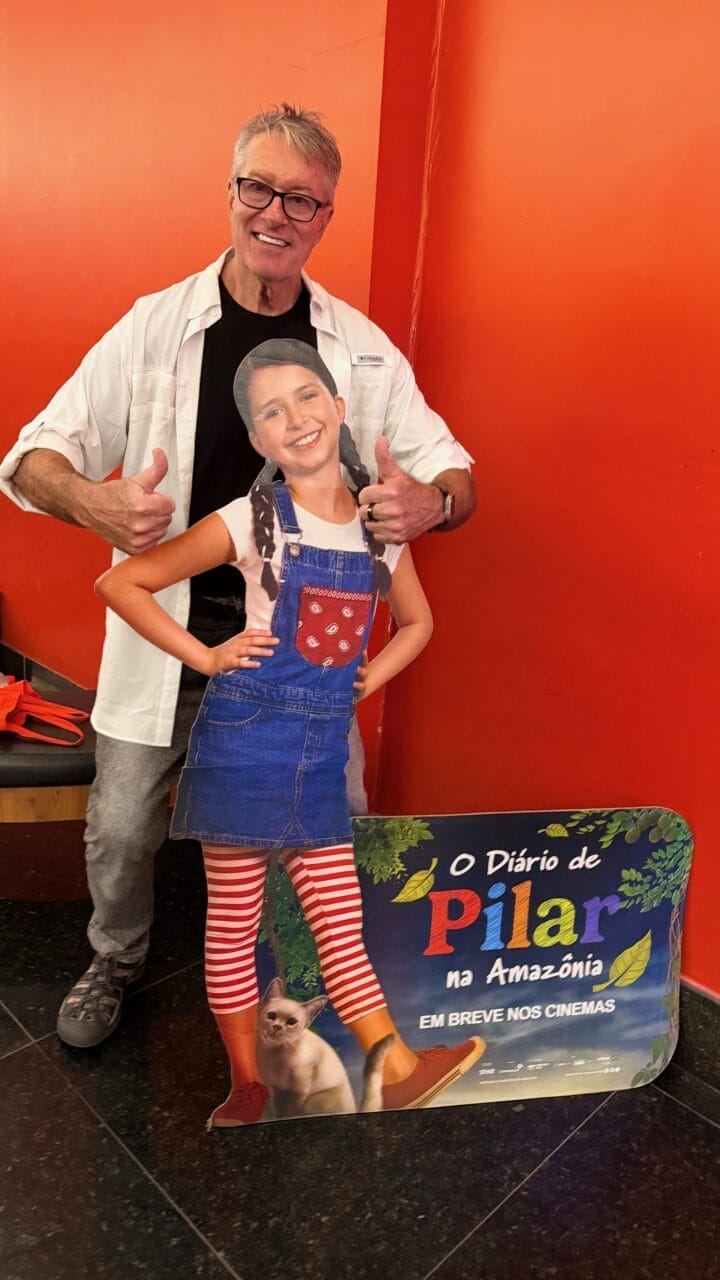
Marucia’s cousin is Flávia Lins e Silva, one of Brazil’s most beloved children’s and young adult authors, best known for her Diário de Pilar series — the adventures of Pilar, a spirited, curious girl who travels the world via a magic hammock inherited from her grandfather, always defending nature, animals and the people she meets along the way.
We enjoyed an evening with Flavia, her husband and young daughter at their apartment in Rio. They were warm and gracious, characteristically Brazilian.
Flavia’s series has sold more than 800,000 copies in Brazil alone and has been translated into eight languages. One of the most popular books in the series is Diário de Pilar na Amazônia, in which Pilar travels to the Amazon rainforest and becomes entangled in a mission to stop illegal deforestation and help a young riverbank girl named Maiara find her family.
During our stay, that book became a film. O Diário de Pilar na Amazônia — a live-action production co-produced by Disney’s Star Original Productions and the Brazilian studio Conspiração — opened in cinemas on January 15, 2026. We went to see it, naturally. It was wonderful.
The film was shot on location in Belém, Alter do Chão (one of the exquisite river beaches on the Tapajós, which features in CroisiEurope’s Amazon itineraries) and Rio de Janeiro.
On screen, the Amazon looked exactly as I had imagined it: vast, luminous, alive with stories and danger and beauty. The film carries a strong environmental message — the destruction of the rainforest is not backdrop but plot — and left us in a contemplative mood.
Sitting in a Brazilian cinema, watching a film written by a member of Marucia’s family, set in the river system idea we are planning to navigate with a group of travelers in a few years’ time gave me the sensation of things converging. Brazil has a way of doing that.
What Americans Should Know About Brazil
Brazil is remarkably affordable for American travelers right now. Ubers, restaurant meals, newly released films at the cinema, bus and train travel, hotel rooms — all are exceptionally inexpensive by US standards. With a little searching, you can find every comfort of home without paying American prices for it.
One financial caution: Beware of Dynamic Currency Conversion when paying by card. You may encounter a screen asking whether you’d like to pay in USD or local currency. Always choose the local currency. Choosing USD hands the conversion rate to the bank at a significant markup. It presents itself as a convenience; it is not.
One pleasant cultural surprise: The treatment of seniors. Brazil has a formal system of preferential treatment for older travelers — dedicated parking, priority lines at airports (making security considerably smoother), priority lines at department stores, movie theaters and government offices. It is baked into the culture in a way that feels genuinely respectful rather than performative. Even city bus transportation is free for seniors.
And the people themselves? Simpático is the word that keeps coming to mind. Warm, generous and welcoming. Within a week of arriving in Manguinhos, I knew many of the beach vendors by name — and made many new friends. Brazil has that effect.
Before or After the Amazon: A Practical View

A word on timing before we get to itineraries. CroisiEurope’s Amazon sailings range from 11 to 17 days and can be extended with stays in Rio or Iguazu Falls. I’d like to go further — to bring my group to Vitória and Manguinhos, to show them the Brazil I spent six weeks getting to know. The Brasilian Dream is already fully committed through 2028; we are planning our group voyage for 2029. Details to follow. But first, the case for slowing down.
The core itineraries depart from and return to Manaus, the improbable jungle metropolis at the confluence of the Rio Negro and the Amazon. But CroisiEurope offers combination packages that build in time in Rio de Janeiro and/or Iguazu Falls — and having now spent two months on the ground evaluating options, my strong recommendation is to take them.
Rio at the beginning or end of the journey makes perfect geographic sense: Most international flights into the Amazon region connect through Rio or São Paulo, so the detour is modest and the reward considerable. Several days in Rio gives you time to acclimatize, recover from long-haul travel and genuinely experience the city rather than merely transit it.
The Espírito Santo coast — Vitória and villages like Manguinhos — is for the traveler willing to go slightly further off the beaten track in exchange for a more unfiltered Brazil: less infrastructure, more authenticity, extraordinary seafood and the warmth of a community that hasn’t yet calibrated itself to foreign tourism. For a group seeking to understand Brazil beyond its famous icons, this coast is worth the additional days.
And Iguazu Falls, straddling the border with Argentina, is simply one of the great natural spectacles on Earth. If it’s at the end of your itinerary, it’s a fittingly dramatic way to close the loop on a journey that began in the Amazon basin.
Final Thoughts
On the rooftop of the Yoo2 Tapestry on our last evening, Marucia and I talked for a long time over caipirinhas — and found ourselves agreeing that the best one we’d had in all of Brazil had been in Domingos Martins, of all places, and for less than half the price. Sugar Loaf and Cristo Redentor presided over the city from their perches above, the two landmarks glowing above the city in the fading light.
But I kept coming back to tastes. The caipirinha. The moqueca arriving in its clay pot. The queijo coalho charring on its stick. And further back, to the simplest thing of all — Jorge cracking a coconut with his machete and handing it over, drinking the água de coco straight from the shell while the sea crashed against the shore under a bright sun. Cool, faintly sweet, like the country itself refreshing you before you knew you were thirsty.
And I thought about the travelers I hope to bring here in 2029 — to walk some of these same streets, eat from the same clay pots, let a beach vendor learn their name. Brazil deserves more than a connecting flight and a day in Rio. It rewards the traveler who lingers.
As we gazed out at Sugar Loaf and the illuminated figure of Cristo Redentor presiding over the city, I thought about all that Brazil had given us — the monuments, yes, but also the tastes, the moments — and this one most of all: the two of us on a rooftop, caipirinhas nearly gone, neither of us quite ready to leave.
If you can build in time before or after the cruise to know Brazil a little more broadly — to walk a beach at sunrise, talk with the locals, let a vendor learn your name — you will leave with something richer than an itinerary.
You’ll leave, as I am today, already planning to come back.
For more information on CroisiEurope’s Amazon cruises aboard the RV Brasilian Dream, including itineraries starting at $6,908 per person, visit croisieuroperivercruises.com. Departures begin January 2027.

-
Two Months In Brazil: Samba, Soul & The Road To The Amazon

I spent nearly two months in Brazil — from a quiet fishing village on the Espírito Santo coast to the streets of Rio — researching an Amazon river cruise I’m planning to host. Here’s what the country taught me before I ever set foot on the river.
-
CroisiEurope Amazon Cruises On The Beautiful Brasilian Dream

Beginning in 2027, CroisiEurope will sail the Amazon River aboard the luxurious Brasilian Dream. With just 32 passengers, this intimate ship offers gourmet dining, spa experiences,and vibrant décor inspired by local crafts. Beyond the ship, guests will enjoy sunrise boat rides, encounters with pink dolphins,and time spent with indigenous communities in one of the planet’s…


One Response
Many years ago (1975) my husband and I did a vacation in South America. Our first stop was Lima, Peru. We wanted to get toMacchu Picchu. We toured the area to see the history of the Inca sites, amazing people that had the knowledge to build what they did so many centuries ago. We rode the train toMacchu Picchu and explored the mountain top city. From there we flew to Iguasu Falls. Then we moved on to Rio De Janeiro. I got goose bumps when I read your email. It reminded me of the things we saw and experienced there. Of course the Christ statue and Sugar Loaf were highlights of the stay there. We experienced a pre-carnival celebration. We were there a week before. It was wild and beautiful. I’m not a professional writer by any means, but I wanted to share this. I’m so happy for you to be able to share your experience there with you wife, who grew up there. “Lucky you 🤣”. I live in Canada