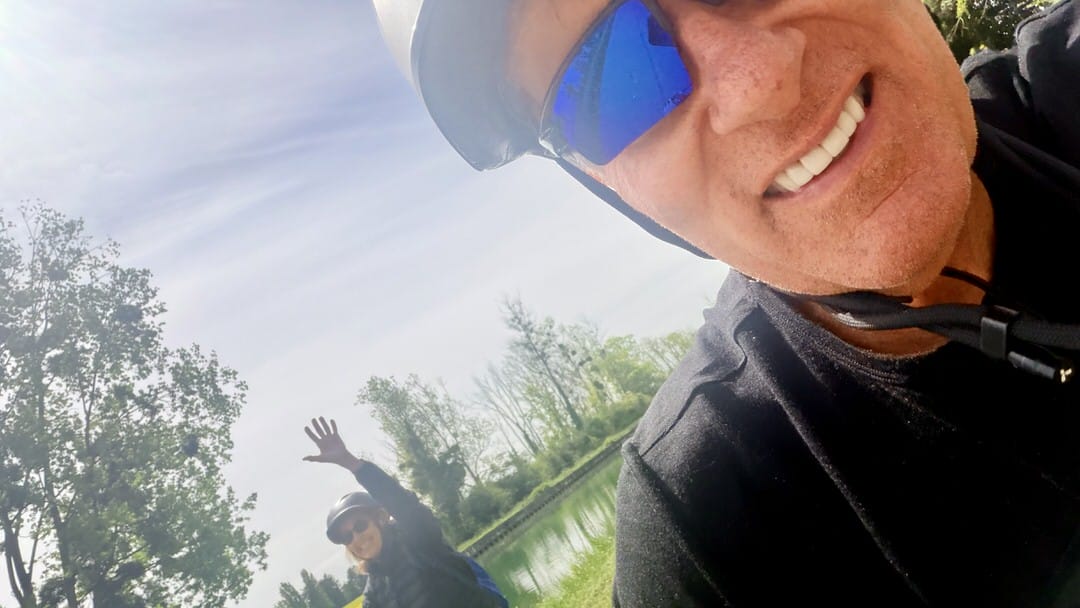
It is a gorgeous April morning. Sunlight dapples through budding trees lining the canal banks, and the water ahead of the barge catches it in slow, glinting swirls. Birds call from somewhere in the new growth — competing, it seems, to be heard. We are experiencing some of the best that spring in France has to offer.
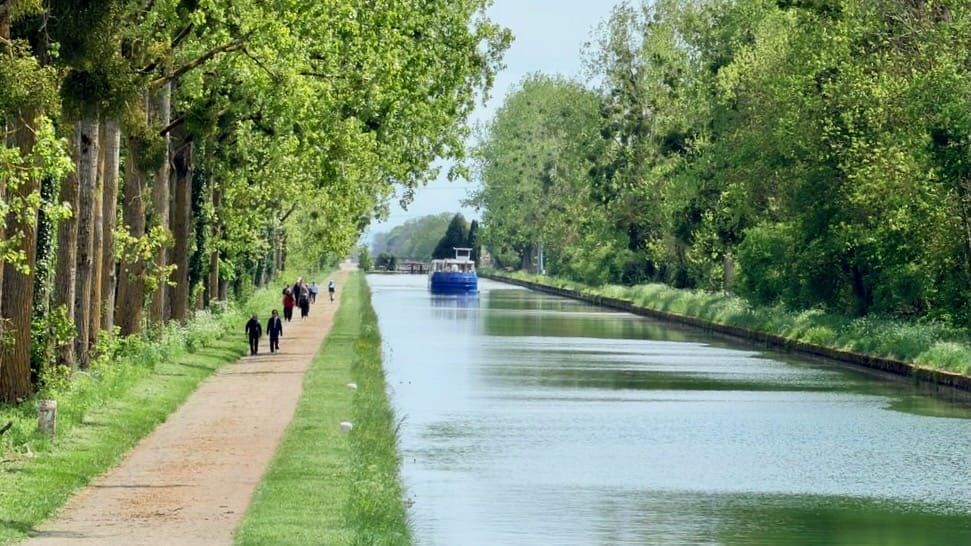
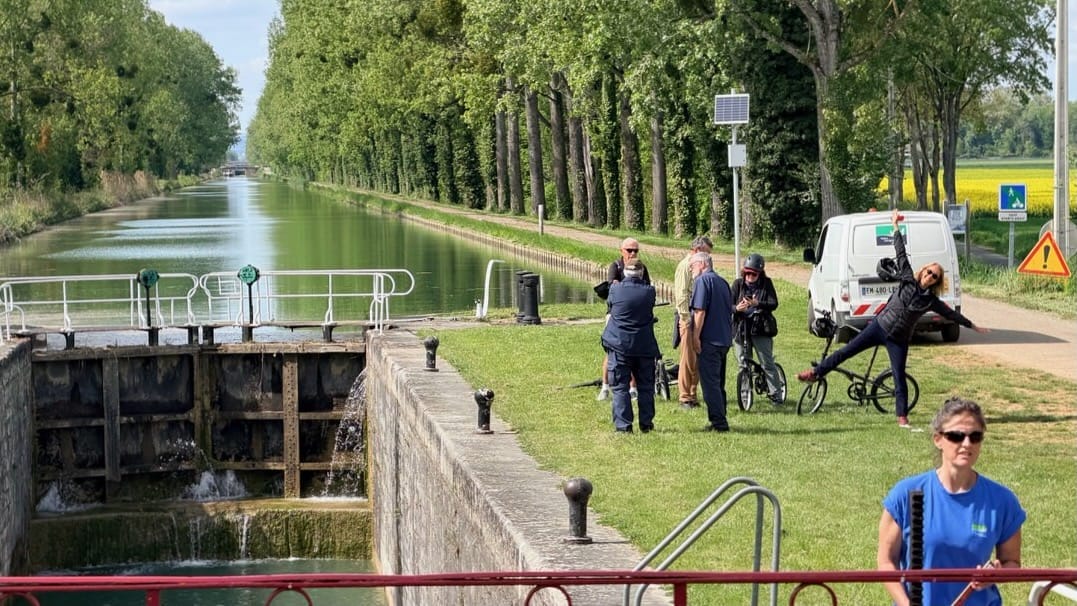
And yet we are not on the barge. We are beside it. Deliberately. We are walking the towpaths that trace the canal. The barge will meet us at the next lock at roughly the same time we arrive. The locks control the rhythm. Our barge moves at the pace of the locks it passes through, and there are 54 of them on this journey. They set the tempo for everything that follows.
Not So Far, Not So Fast
Plotting a route from Besançon to Dijon shows that an ambitious walker could cover the distance in a day and two hours — 52 miles at a pace that would leave most people destroyed. Even at a relaxed stride, experienced walkers might manage it in four or five days. A cyclist could tackle it in a day. By car, you are there in 90 minutes.
We boarded the Danielle in Besançon on a Thursday evening. We disembark in Dijon on Wednesday. Seven days to cover 52 miles. It is, as it turns out, exactly the right pace for this particular stretch of France.
The route is not a single waterway but three. We began on the Doubs, a river that cuts through Besançon and winds west — tamed by locks for navigation, though wild sections run alongside the canals, the river doing what it wants just beyond reach. Where the Doubs meets the Saône, the character of the journey shifts — broader water, wider skies. By Sunday we had tied up in Saint-Jean-de-Losne, where the Saône gives way to the Burgundy Canal and the waterways of half a continent converge. That afternoon, I pulled a foldable bike off the Danielle and went looking for what the towpath had to offer.
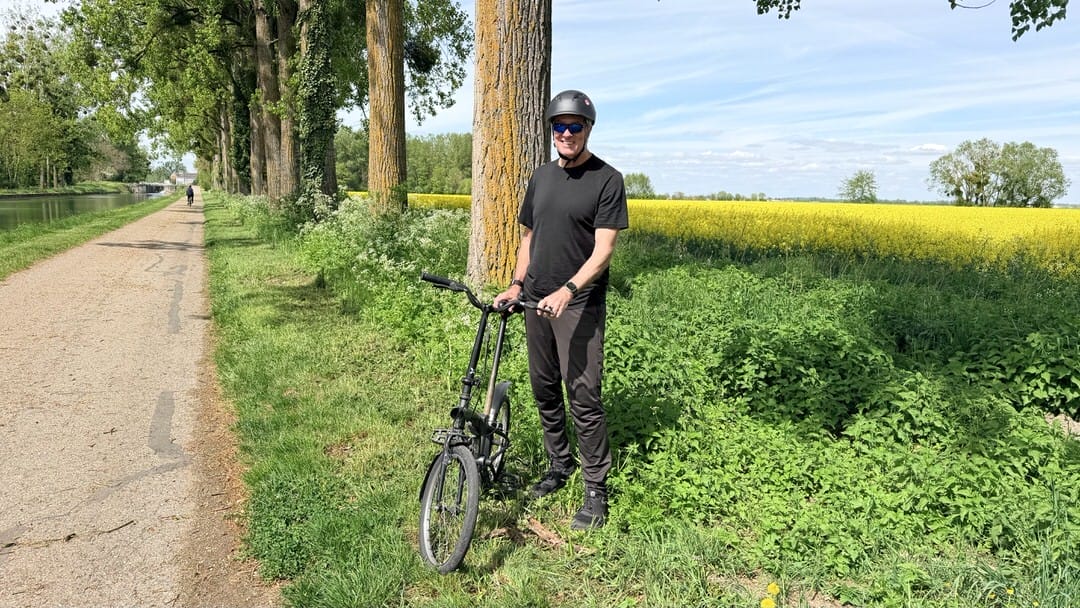
By mid-afternoon I am pedaling through Saint-Jean-de-Losne on a foldable bike — 20-inch wheels, a bit small for me, good enough. The rest of my group are off on a guided tour of the city, including the barge museum, one of the more educational stops on this stretch of the trip. I chose to skip the tour. I have been here before, and I wanted to ride.
Saint-Jean-de-Losne is quiet in the way that places with outsized histories often are. It is the inland waterways capital of France, the point from which you could navigate to the Mediterranean, the North Sea, the Rhine, the Black Sea. The canal network spreads from here in almost every direction, and standing at the quay you understand immediately why this small town was once one of the most important places on the continent.
The Danielle is tied up on the Saône, near where it meets the canal. I’ve left the river behind and taken a back road toward the Burgundy Canal, a road better suited to gravel bikes than this folder. But my eyes are on the golden quilts of rapeseed fields. The plant stands five or six feet high, flowering in a yellow so saturated it reads almost unreal against a cobalt blue sky. A row of trees borders the road, planted uniformly, maybe 20 feet apart — old enough that I couldn’t wrap my arms around them. Against the new growth, that particular pale green of early spring, the scene has the quality of something composed rather than something simply sown.
The trees are full of mistletoe — great green balls of it, round and improbable, like something out of a Dr. Seuss book. At one point or another, everyone has noticed it and remarked on it, charmed by what looks like decoration. It is not. Mistletoe is a parasite. Left unchecked, it could eventually kill its host.
Backroads in Burgundy
The back road becomes the towpath along the Burgundy Canal — the same packed earth path once used by the draft animals and sometimes the people who hauled cargo barges from town to town before the age of steam, a modernization that was born nearby. See Where River Cruising Began: A ‘Fire Boat’ On The Saône
France built nearly 5,000 miles of navigable waterways over three centuries, and the towpath was the muscle behind all of it, a living chain of men, women, horses and oxen straining against the current. The Burgundy Canal is one of the most traveled of these waterways, rivaled in popularity only by the Canal du Midi in the south and the Canal du Nivernais to the west. Among my favorites is the Canal de la Marne au Rhin in Alsace, which passes through Saverne on its way from the Lorraine plateau down to Strasbourg — a different character entirely, the towpath threading through the Zorn valley with locks appearing around nearly every bend.
Today the paths carry cyclists, roller skaters, pedestrians. I pass a lockkeeper’s house, then another, then another — each one different in color and form, stone here, render there, a blue shutter, a red door, small gardens gone a little wild. They appear unoccupied now, beautiful vestiges of a system that once moved the goods of a continent. The locks still require tending, and the lockkeepers still travel the towpaths between them. The barges still come through, although travelers have taken the place of cargo. The path endures.
Bike & Barge
I stop pedaling and let the bike roll to a coast. A few days earlier, in Dole, I had spotted a EuroVelo 6 sign at the city center pointing in the direction of Budapest. I pulled up my map and calculated that the Hungarian capital was more than 900 miles away. I longed to ride it, and in fact I’ve done quite a few sections of EuroVelo 6.

EuroVelo 6 is one of the world’s great cycling routes — 2,700 miles in all, from the Atlantic coast of France to the Black Sea, following the Loire, the Rhine, the Danube through ten countries. It is a route designed for exactly this pace: close to the water, moving through the interior of a continent rather than skimming its surface. I have cycled across America, across Canada, both islands of New Zealand, through Europe. I have covered a lot of ground on a bicycle over the course of a life. Riding sections of EuroVelo 6 on this trip, even briefly, even on a 20-inch folding bike that was never meant for the purpose, felt like making good on something I had been promising myself for a long time. A route I may never complete in full. One I am glad to have touched many times over a life spent writing about river cruising.
I am alone for a stretch, and I understand, not for the first time, why I keep doing this.
It is not complicated. My eyes need to see new things. I need to hear foreign languages, try to speak them badly and be forgiven for it. I need new smells — a baguette just out of the oven, fields of lavender or, as right now, rapeseed in full bloom, a fragrance that is faintly green and completely itself. I need to feel the sun on my skin, hear the birds, feel my lungs fill and empty, fill and empty. It is a simple proof that I am alive and getting something from the life I have chosen. I do my best to describe the feeling that it gives me and know I will never do it justice.
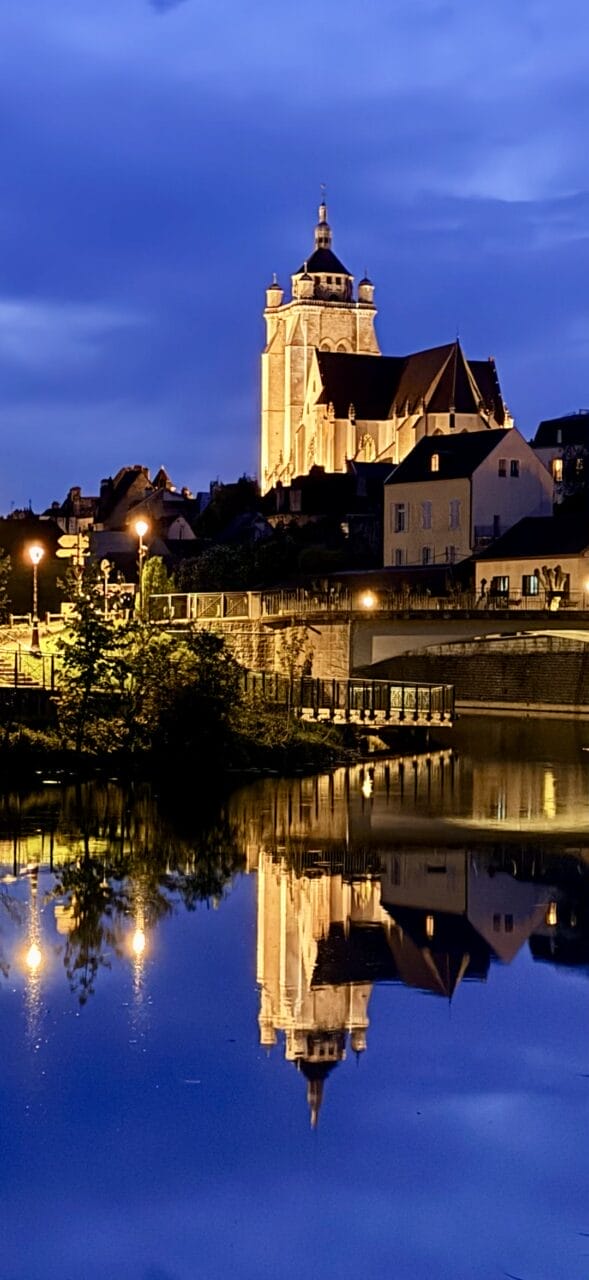
France, Fragrant & Freeing
A few days earlier, before we boarded, Tim and I had been walking the banks of the Doubs through Besançon on a brilliant morning — the kind of day that makes a city feel open and generous. The river runs wild in an oxbow around the city, and though we were technically in Besançon, we felt far removed from it, the urban world somewhere behind us and above us, irrelevant. Tim is a friend from California, the kind of person who approaches everything with an almost childlike curiosity — forever noticing, forever asking why. Meanwhile Marucia and Anne, his wife, had peeled off toward the city center, drawn to the shops and cafés the way sensible people are on a beautiful morning. Tim said something on that walk that has stayed with me: France has a quality of orderliness that is not quite manicured, more like tended. Fields in their patches, trees in their rows, everything legible and calm.
Riding the towpath this afternoon, I understand what he meant. There is no ambient uncertainty here. A person on a small bike is accounted for in this landscape, the way the fields and the trees and the locks are accounted for. Everything legible and calm.
I returned to the Danielle in the late afternoon to find the crew had set up pétanque on the quay. They had told us this was coming — along with pastis, pâté and the kind of small French provisions that make an afternoon on a canal feel like something out of a film you did not know you wanted to see. There were a lot of laughs. Then another excellent dinner by An, our chef.
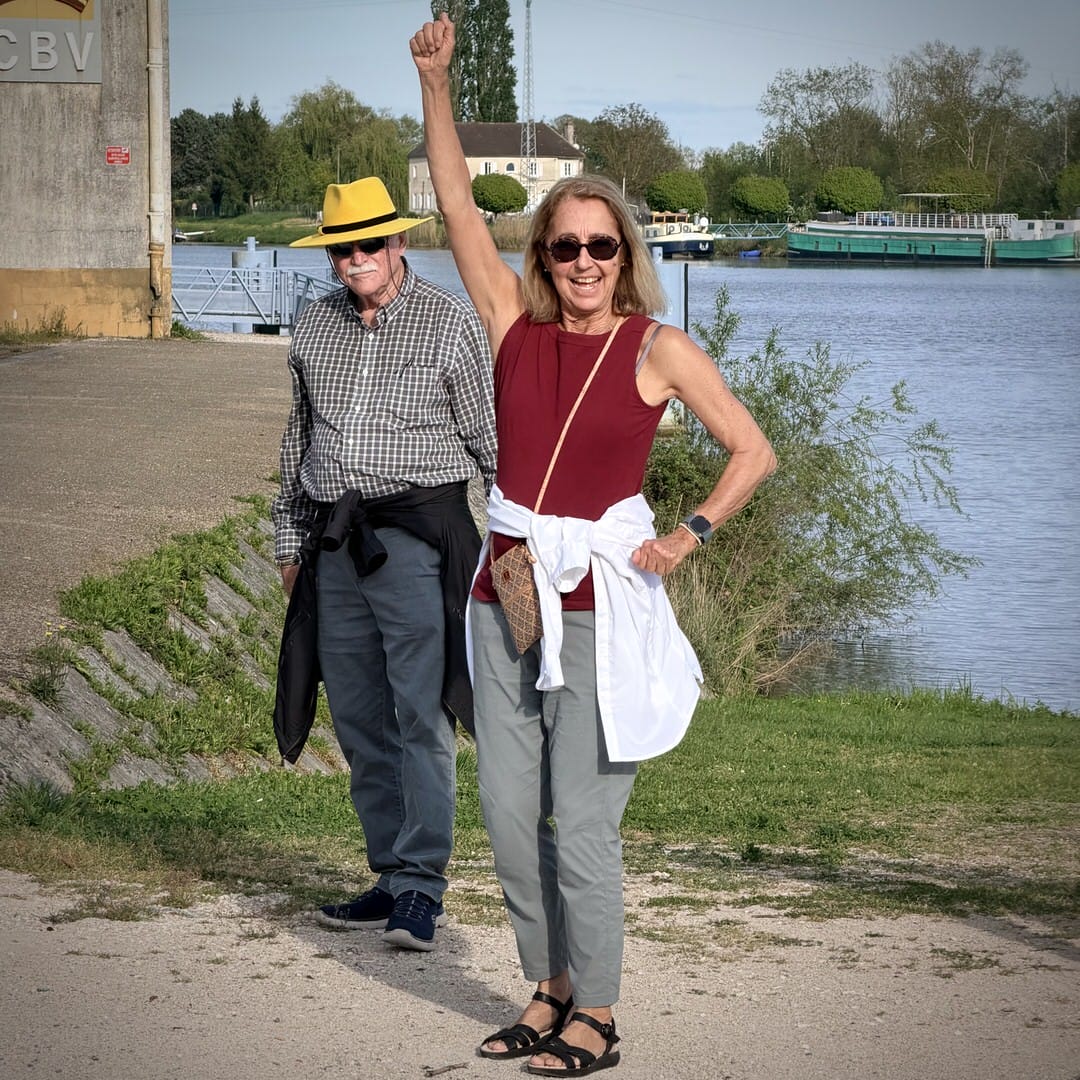

We are docked on the Saône tonight. Tomorrow morning we head up the Burgundy Canal.
I will ride again. This time I will bring a few of the others and show them what I found out there — the rapeseed fields, the towpath, the mistletoe perched in the trees, the joy of tapping the brakes on life and moving through it at exactly the right pace.