
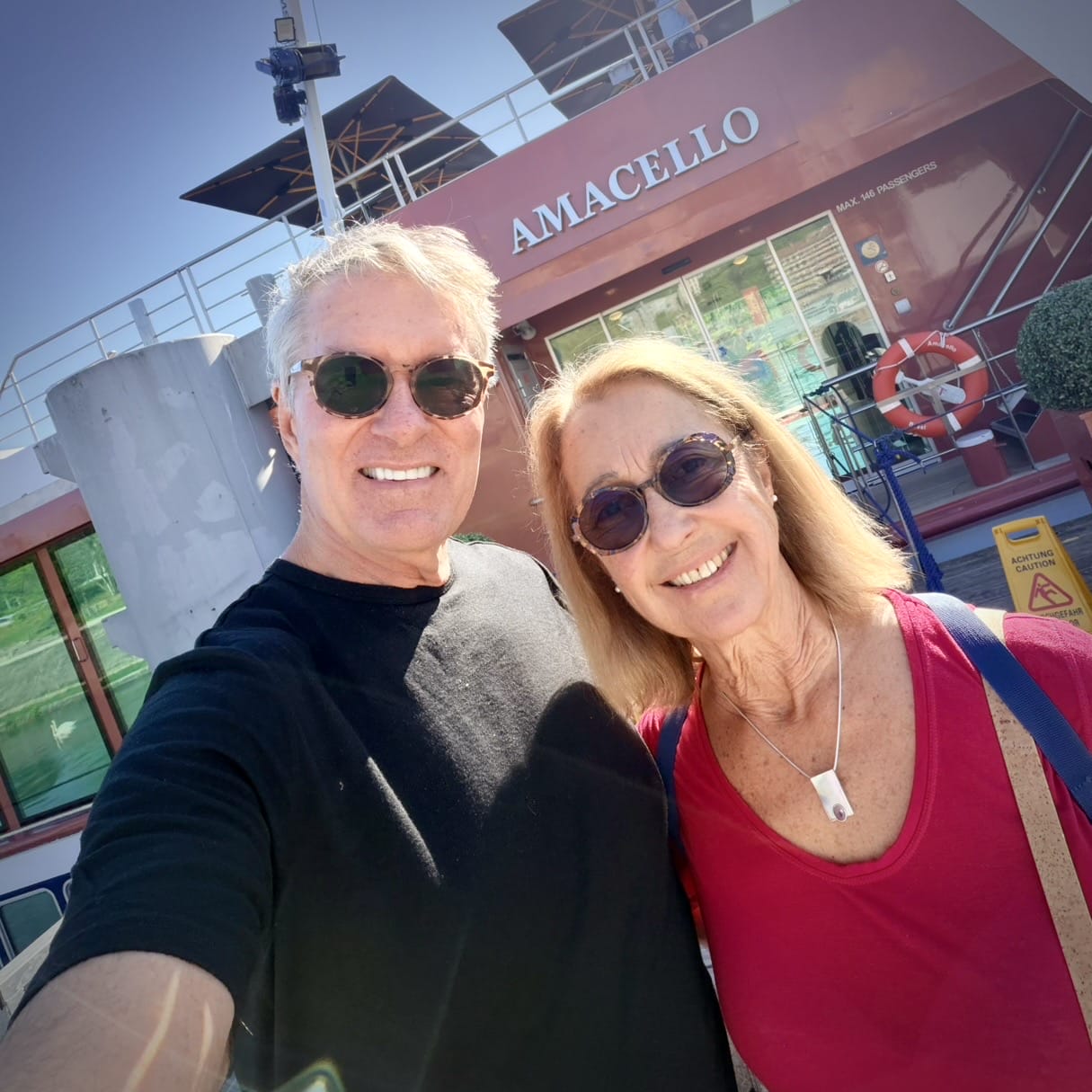
We are not dancers. We took salsa classes recently — just for the fun of it. Dancing is something that happens to other people, people who go out to night clubs, ballrooms and lounges or attend weddings.
And yet. On several nights, we found ourselves on the dance floor on the AmaCello, often the first ones there. Marucia and I, moving together in the ship’s lounge, as others joined, the windows dark around us.
On most nights, our world became the music and the people and the particular warmth of a room where everyone has spent the day walking the cobblestones, standing before cathedrals, crossing bridges — and now had nowhere else to be other than bed. We stayed up to dance.
We don’t do that at home. Life is too busy. And at the end of a long day we are content to plop down on the sofa and watch television. But not on the AmaCello. We walked the cities where we docked after dinner, returning to our ship, to dance. Slow dances, fast dances, old and new dances. We had the sensation of floating, and indeed the floor beneath us was doing just that, on the Saône, in a city, on a lovely night where music and romance mixed, like an old movie where we were the actors.
Transported & Transformed
My daughter has sailed AmaWaterways before, and when I told her about those evenings, she said, matter-of-factly, “AmaWaterways is the cruise line where people dance.” She wasn’t wrong. I had seen it too on other AmaWaterways cruises. I had danced myself but never as I did on this trip. Being with someone special on a river cruise with no pressing agenda, nowhere else to be, transported me.
That’s the thing about a river cruise that we keep trying to explain to people who haven’t taken one — it takes you in two directions at once. There’s the literal journey, of course: the slow drift through Burgundy, the vine-covered landscapes, the medieval towns materializing and then dissolving at the water’s edge. But there’s also the other kind of transport, the interior kind, where the ordinary weight of your life — the inbox, the obligations, the accumulated noise of being a person with responsibilities — simply lifts.
One woman in our group said it was the first time she’d been able to truly relax in longer than she could remember. She carries a full life at home — the kind that doesn’t pause easily. But somewhere on the AmaCello, between one port and the next, something let go. Not a vacation where you come home needing a vacation. Real relaxation. The kind that changes something.
We think the river has something to do with it. Moving water carries you even when you’re standing still. There’s a rhythm to it — the gentle push of the current, the unhurried pace of the days, the simple act of floating. Somewhere in that rhythm, people become different versions of themselves. Quieter in some ways. More open in others. More inclined to let the concerns of their lives drop and take that first forward motion to the floor — to dance.
One moment that stays with me happened last year on the Rhône. Ed, who travels with our groups, brought his wife Carol to the dance floor. She had suffered a stroke more than a decade ago and uses a wheelchair. Ed wheeled her out among the other dancers and danced with her there, the two of them moving together in their own way, in their own time.
The Dance Continues
During those nights that we danced on AmaCello, we didn’t know that it had given us something we would carry with us. Two weeks later, we were in the final days of our Camino adventure. We stopped for morning coffee at a bar in Burgos. A friendly young man took our order for two café con leches. An older man sat at the counter, sipping coffee and reading the day’s edition of the Diario de Burgos. Another sat in the corner, eyes fixed on his laptop. A jukebox played a Latin rhythm, unhurried and familiar.
Neither of us hesitated. We took each other’s hands and danced.


