
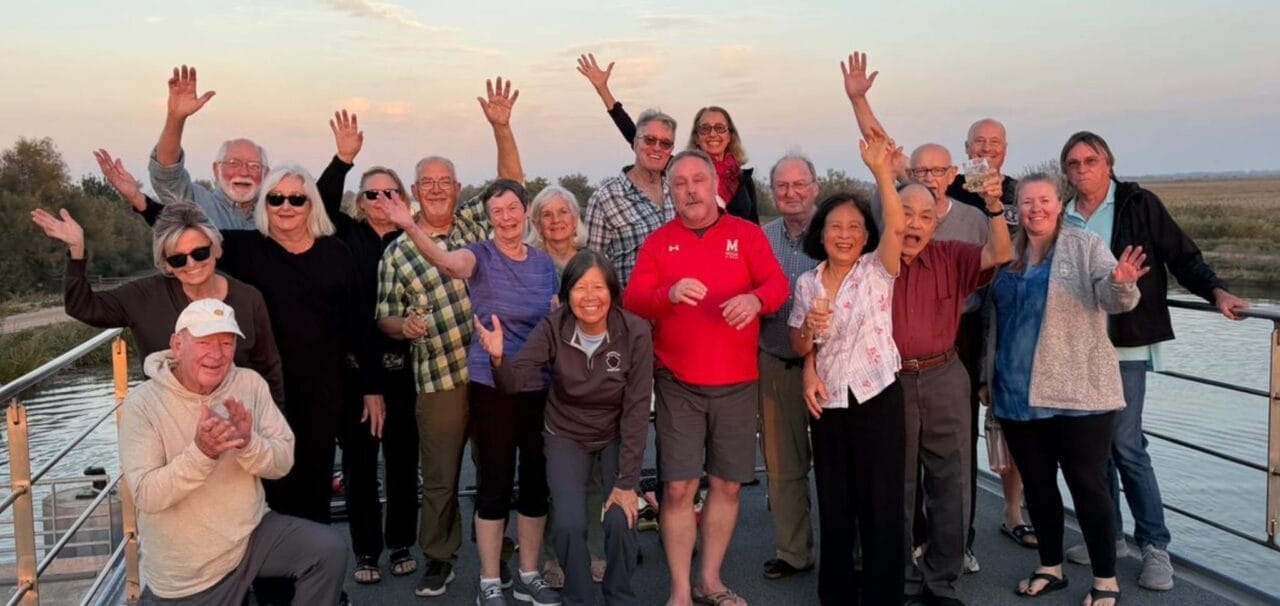
On October 5, Marucia and I leave San Francisco for France, where we’ll spend most of the month moving gradually south — from Strasbourg and the canals of Alsace, through Paris and Lyon, down the Rhône, and finally into Provence and the Camargue. It’s not really one trip. It’s several different journeys stitched together. It’s a style of travel that we enjoy, making the most of the transatlantic flight and our time abroad.
I’ll host two barge departures, first aboard Madeleine in Alsace and Lorraine and later aboard Anne-Marie in Provence. Between them, Marucia and I will spend a few days in Paris with good friends and then sail four nights aboard Riverside Ravel on the Rhône for a River Cruise Advisor reporting trip.
By the time we fly home from Marseille on October 30, we’ll have traveled on two barges, one river ship and more than a few trains, with plenty of walking and cycling in between.
What appeals to me most, though, is that much of this journey is about returning rather than discovering. I’ve been fortunate to spend a great deal of time in France over the years. Increasingly, I find that going back to places I already know can be every bit as rewarding as seeing somewhere new.
Our Month In France At A Glance
Oct. 6–8: Strasbourg
Oct. 8–14: Madeleine — Alsace & Lorraine
Oct. 14–17: Paris
Oct. 17–21: Riverside Ravel — Rhône
Oct. 22–28: Anne-Marie — Provence & Camargue
Oct. 28–30: Arles & Marseille
Back To Strasbourg
We arrive in France on October 6 and take the train from Charles de Gaulle Airport to Strasbourg. I always enjoy returning there. In fact, I have often thought that if I were ever to live in a European city, Strasbourg might be the one. It’s centrally located, with Germany just across the Rhine and Paris only a couple of hours away by high-speed train. More important to me, though, it is a bicycle city, a river city and a canal city.
There’s family lore suggesting that my family may have come from Strasbourg or this part of Alsace. I’ve never been able to confirm that, so I wouldn’t make too much of it. Still, I’ve always felt a connection to the place.
We’ll stay for two nights at Hotel Rohan, which I like in large part because of its location near Strasbourg Cathedral. Step outside and you’re immediately in the historic center. And only steps away, there will almost certainly be another tarte flambée, an Alsatian specialty of thin, crisp dough topped with crème fraîche, onions and bacon, then baked quickly at high heat.
I love Alsace: the food, the villages, the half-timbered buildings, the vineyards, the Vosges Mountains and the way French and German influences have shaped the region. On October 8, we’ll once again experience it at a considerably slower pace.
Forty-One Locks Aboard Madeleine
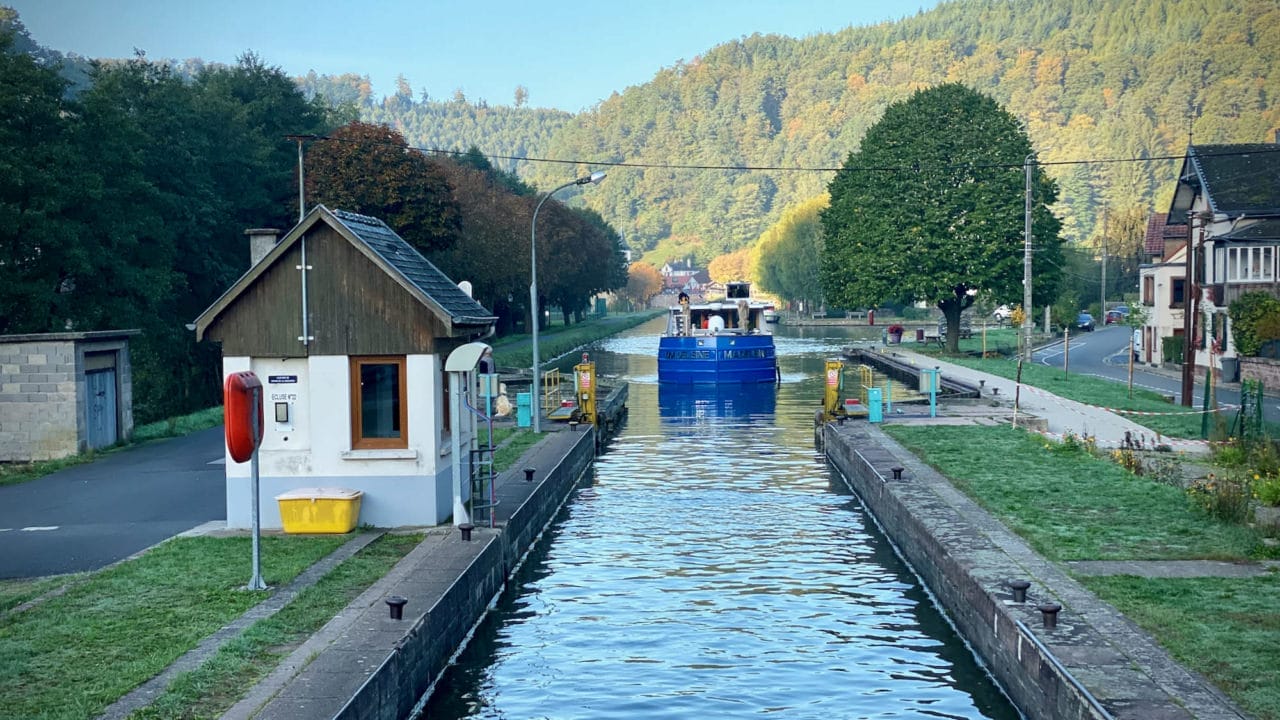
I’ll be hosting our first barge trip of the month aboard CroisiEurope’s Madeleine. The seven-day journey takes us from Strasbourg to Lagarde along the Marne-Rhine Canal, calling at Waltenheim, Saverne, Lutzelbourg and Xouaxange along the way. The route covers only about 65 miles, yet includes roughly 41 locks.
For someone trying to get somewhere quickly, that might sound like a problem. For me, it’s one of the attractions. Hotel barges move slowly enough that the landscape doesn’t simply pass by outside a window. Along much of this route, paved towpaths make it possible to get off the barge, walk or bicycle for a while, and rejoin farther along. The locks actually make that easier.
You may leave the barge, ride ahead along the canal and then see Madeleine gradually catch up as she works her way through the next lock. That intimacy with the landscape is one reason I continue to enjoy barging so much.
Our route will take us past villages such as Schwindratzheim and Hochfelden before reaching Saverne. The itinerary includes time to walk or cycle along the canal and a visit to Château du Haut-Barr, known as the “Eye of Alsace” for its views over the plain. That evening, appropriately, tarte flambée is on the program.
From there, the canal winds into the Vosges toward Lutzelbourg. One of the journey’s most unusual features is the Saint-Louis-Arzviller Inclined Plane, an extraordinary piece of canal engineering that carries boats up or down the hillside in a giant water-filled caisson.
We’ll also pass through canal tunnels, with a candlelight lunch planned during the passage, and visit Sarrebourg and its Chagall trail.
But the thing I’m most looking forward to may be simpler than any excursion. A bicycle. A towpath. Autumn in the Vosges. And a barge moving alongside us at walking speed.
Three Days In Paris
We leave Madeleine on October 14 and return to Strasbourg, then take the train to Paris. Who doesn’t love Paris? For me, much of the pleasure is simply walking. There doesn’t always need to be a monument at the end of the walk. Paris rewards wandering: crossing a bridge, turning onto a street because it looks interesting, stopping for coffee, then starting again.
We’ll be with friends during our stay, and one morning will also have a purpose that will prepare us for my 2027 barge trips (only one of the two trips currently has cabins available).
On October 15, Marucia and I will join chef Edward Keller for a private exploration of the Montorgueil and Les Halles neighborhoods. Our friends Chafin and Jennie will come along, and afterward we’ll take E.J. to lunch.
His Montorgueil programs combine the food shops of one of Paris’s historic market districts with landmarks including Saint-Eustache, the Bourse de Commerce, Palais Royal, Galerie Vivienne and Place des Victoires. Market versions of the tour include tastings of cheese, chocolate and other specialties.
E.J. also has an interesting story. Originally from California, he moved to France in 1996 with his French wife and eventually worked in Paris restaurants including Le Grand Véfour and L’Escargot Montorgueil before starting his own personal-chef business. He has lived in the Montorgueil neighborhood for years.
I’ll be photographing and writing about the experience for River Cruise Advisor. E.J.’s Paris programs will be a good fit for our guests in 2027.
Then, on October 17, we’ll leave Paris for Lyon.
From A Small Barge To Riverside Ravel
The transition should be interesting. After a week on a small hotel barge, Marucia and I will board Riverside Ravel for a four-night Rhône cruise. We’ve gone from barge to river ship before, just last year in fact, but this will be a different experience: a four-night voyage instead of seven.
That is partly why I wanted to do it. For those who enjoy Europe and don’t want to commit to seven nights on a river cruise, four nights on Riverside Ravel might be just the ticket. We’ll get to experience nearly as much as we would on a seven-night journey. Our Riverside itinerary begins in Lyon and continues through Vienne, Tain-l’Hermitage, Viviers and Châteauneuf-du-Pape before ending in Avignon.
The Rhône has long been one of my favorite rivers. Lyon is one of Europe’s great food cities, and farther south the itinerary takes us through places I never tire of visiting. Tain-l’Hermitage brings together two rather appealing subjects: Rhône wines and Valrhona chocolate. Viviers is one of those small Rhône towns that rewards simply walking uphill through old stone streets toward the cathedral and views over the valley. Then comes Châteauneuf-du-Pape, where papal history and wine have been intertwined for centuries, followed by Avignon and its great medieval legacy.
This will also be a reporting trip, so I’ll be looking closely at Riverside itself: the ship, service, food and the experience aboard Ravel. I’ve thoroughly enjoyed my time on Crystal River Cruises, the now-defunct company for which Ravel was built. And I have enjoyed my time on Riverside Mozart. I’m eager to see what Ravel is like under Riverside’s fine management.
On October 22, we switch scales again. Back to a barge.
Anne-Marie And The Camargue

Our second hosted trip begins aboard Anne-Marie, sailing from the Sète area toward Arles through Provence and the Camargue. The itinerary starts around the Étang de Thau, known for its shellfish production, and includes a visit to Saint-Guilhem-le-Désert before joining the Rhône à Sète Canal. From there, we move into one of my favorite landscapes in France.
The Camargue is magical. It is a world of wetlands, enormous skies, white horses, black bulls, flamingos, salt marshes and beaches. We’ll visit a traditional manade, where the region’s horses and bulls are raised, then continue toward Aigues-Mortes.
Aigues-Mortes is one of those places that looks almost improbable when you first approach it: a remarkably intact medieval fortified town rising from an otherwise flat landscape of marshes and salt.
Eventually, Anne-Marie will take us to Arles, where the itinerary includes its Roman heritage and a look at olive-oil production in Provence.
But this departure has something the printed itinerary doesn’t mention. Our friend David Wilcox will be traveling with us. David is a singer-songwriter and a gifted storyteller, and he’ll have his guitar along. This is not a concert cruise. There won’t be a formal stage or a nightly performance schedule.
David is coming as a friend, and he’ll play informally. And he’ll be joined by my good friends (and David’s manager), Steve and Lynne. I look forward to the impromptu moments when David picks up his guitar. Some of the best moments in travel are the ones nobody schedules.
A small barge in Provence, a group of people who have spent several days together, and David Wilcox with a guitar sounds like a pretty good setting for one of those moments.
Ending In Arles And Marseille
Our barge trip ends in Arles on Wednesday, October 28, which should give us one more pleasure before the trip is over: the Wednesday morning market on Boulevard Émile Combes. It’s smaller than Arles’ sprawling Saturday market, but still very much a Provençal market, with local produce, cheeses, olives, meats and other regional specialties.
Marucia and I have walked through the Arles market before, and it’s wonderful. On one visit, we bought Provençal linens, then assembled a picnic from the stalls — fresh bread, cheese and anchovies — and carried it over to LUMA Arles.
LUMA is the contemporary arts campus at the Parc des Ateliers, and its unmistakable centerpiece is The Tower, designed by Frank Gehry. The 56-meter building is clad in 11,000 individually placed stainless-steel bricks that catch and change with the Provençal light. Gehry drew inspiration from several things that define Arles and its surroundings: Van Gogh, the rocky forms of the Alpilles and the city’s Roman amphitheatre. At the base, a vast glass rotunda echoes the form of the ancient arena, while terraces at the top look out over Arles, the Camargue and the Alpilles.
That contrast is part of what makes Arles so interesting to me. You can spend the morning shopping for bread and cheese in a traditional Provençal market, walk past Roman ruins that are nearly 2,000 years old, and then sit down for a picnic beside one of the most striking contemporary buildings in France. It’s all part of the same small city.
Marucia and I, along with other guests, will spend that night at L’Arlatan before continuing to Marseille the following day to visit friends. L’Arlatan is an experience in its own right. The historic property sits in the old center of Arles, but artist and designer Jorge Pardo was given extraordinary freedom to reinvent the interiors. The result is exuberant rather than restrained: vivid colors, unusual lighting, custom furnishings and an extraordinary amount of mosaic — roughly 6,000 square meters made from nearly 2 million handmade pieces. Historic walls and contemporary art sit side by side, so the hotel feels less like a conventional luxury property and more like a large, inhabitable work of art.
Then, on October 30, we fly back to San Francisco. Twenty-five days after leaving.
On this trip to France, what I’m most looking forward to isn’t really a list of attractions. It’s walking beneath Strasbourg Cathedral again. Eating tarte flambée. Cycling beside the Marne-Rhine Canal. Watching Madeleine slowly work through another lock. Walking Paris with friends. Spending a morning in Montorgueil with E.J. Keller. Moving from a small hotel barge to Riverside Ravel and returning to the Rhône. Seeing flamingos in the Camargue. Walking through Aigues-Mortes and Arles. And somewhere along the way, hearing David pick up his guitar.
I’ve been fortunate to travel through France many times. That may be exactly why I’m looking forward to this trip so much. I’m not going because I need to see France. I’m going back because there are parts of France I want to experience again. And sometimes returning can be even better than arriving for the first time.
My France Barges Are Nearly Sold Out. How About Africa?
If you’d like to travel with me in 2027, space on my French barge departures is already very limited. But there is another journey I’m especially excited about: Africa by Land, River & Sky.
From July 20–30, 2027, I’ll host a maximum of just 14 guests on an 11-day journey through South Africa, Botswana, Namibia and Zimbabwe. We’ll combine wildlife safaris by land and water, four nights at a secluded lodge, private-aircraft transfers, four nights aboard the intimate eight-cabin African Dream on Lake Kariba, and a finale at Victoria Falls.
It’s not a conventional cruise and it’s not a conventional safari. It combines the intimacy of small-ship travel with exceptional wildlife experiences, while CroisiEurope handles the complicated logistics of moving through four countries.
Early-booking prices currently begin at $8,676 per person, based on two guests sharing, with savings of approximately $3,000 per cabin through December 30, 2026.
See The 2027 Africa Journey →

