
A barge journey through the Camargue and a river cruise on the Rhône show France at two speeds.
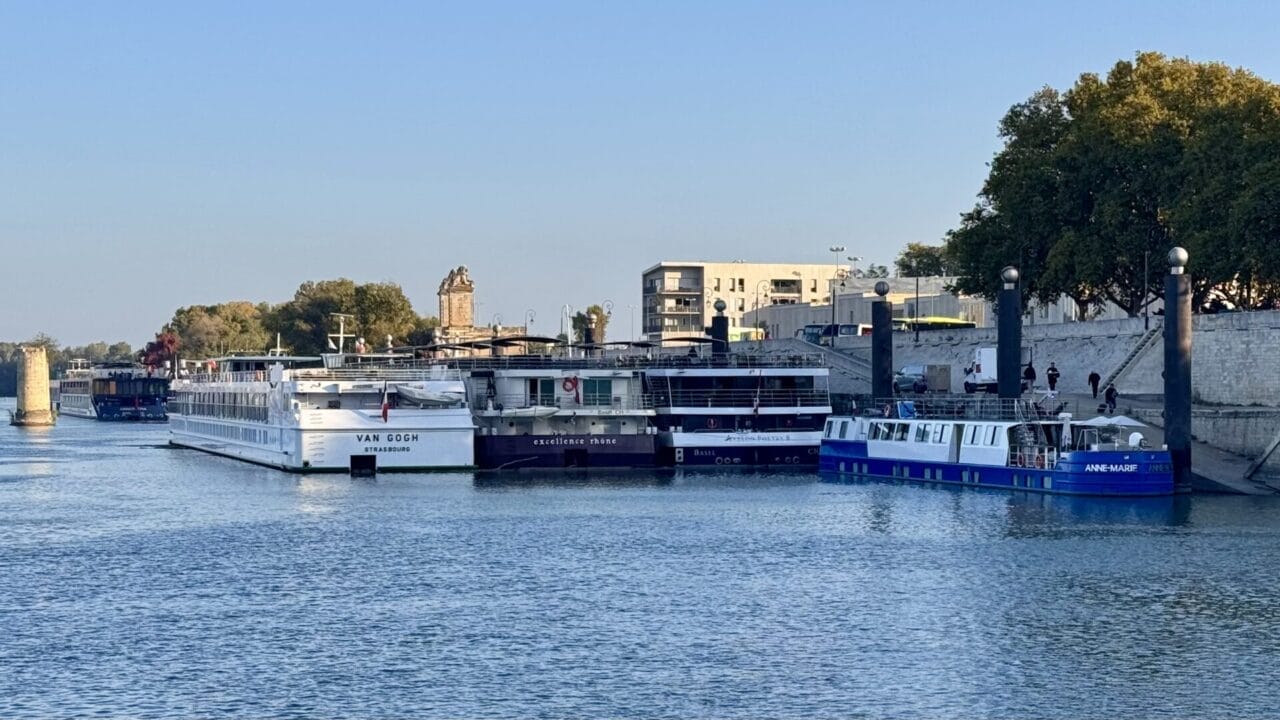
A week after leaving Sète, 10 of us stepped off the barge Anne-Marie in Arles, where our barge journey ended and our next adventure would begin.
This story continues our travels through southern France, as we traded the quiet intimacy of the canals for the steady current of the Rhône River. From Arles, we joined AmaWaterways’ AmaKristina for a weeklong voyage north to Lyon — a river cruise that, paired with our week on the canals, offered two very different ways to experience France.
We had spent the previous days exploring the Camargue, a vast, low-lying delta where the Rhône splits into two branches before meeting the Mediterranean. It’s one of Europe’s great wetlands, a mosaic of salt flats, lagoons and reed beds that shift color with the light. Here, nature reigns: white horses roam freely, black bulls graze on open plains and thousands of pink flamingos feed in shallow pools. The region is also home to the gardians, the skilled horsemen who have worked this land for centuries, herding bulls and horses across its open marshes. We saw all of that and more during our week on Anne-Marie. See Journey Through The Camargue By Barge

Traveling by barge offered the perfect vantage point. We glided along the canals that cross this region of southern France — narrow waterways bordered by levees, with wide lagoons stretching out on either side. From the deck of Anne-Marie, we watched the light change through the day, the reflections on the water and the quiet villages appearing beyond the reeds. It was a France few travelers ever see — tranquil, unhurried and deeply connected to the natural world.
The canals are narrower, quieter and more intimate than the rivers, and so are the vessels that travel them. On this stretch of the Canal du Rhône à Sète, the landscape is open and low-lying, with just a single lock along the route. The pace is slow and steady, close to the land and to everyday life along the banks. There’s time to notice the play of light on the water, the birds rising from the reeds and the way each village seems to appear out of nowhere. The rhythm invites you to slow down — to take in France one bend, one bridge, one quiet moment at a time.
By the time we reached Arles, the landscape began to shift. The wild beauty of the Camargue gave way to something more structured — bridges, boulevards, the trace of history layered in stone. Arles would be our final stop aboard Anne-Marie and the starting point for what came next: a week on the Rhône aboard AmaKristina.
After a night in Arles, we joined 17 others in our group on AmaKristina, with me as the host of a series of sailings I annually bill as my Dream Cruise. Why Dream Cruise? I try to pick the perfect ship on the perfect river with the perfect itinerary at the perfect time of year. If all goes well, the trip should come off as near to perfect as possible.
Indeed, our days on both voyages, the barge and river cruise, were sunny and bright, without the soaring temperatures that can make travel during peak season miserable. The weather turned at the end, with some scattered rain, but overall, we experienced perfect weather for exploring.
Those of us who did both trips also experienced something that most river cruisers never do: barge travel. The difference is profound. On a barge, life unfolds in miniature — smaller scale, slower pace, closer connection. You see the same France, but from just a few feet above the waterline instead of from a grand lounge or stateroom balcony. Each has its charm, but together they offer a fuller picture of the country and the waterways that define it.
Arrival In Arles — From Canal To City
By late morning on our final day, Anne-Marie slipped through the last lock and entered the Rhône. The gentle hum of the engine quieted as the current took over, pulling us from the narrow calm of the canal into open water. Behind us lay a week of slow travel — the still lagoons, the villages, the friendships that form when life moves at five miles an hour.
Ahead, the ochre rooftops of Arles came into view — a city that has drawn travelers for more than 2,000 years. After a week on the canals, it felt almost grand, yet still approachable, a natural progression from the quiet backwaters to something larger and more storied.

Arles is a city of serendipity, where every turn reveals something unexpected — a mural, a Roman arch, a café tucked into a sun-splashed square. We stayed at L’Arlatan, a hotel as much art installation as inn. Its corridors shimmered with mosaics and color, playful yet rooted in the textures of Arles.

The next morning, we visited the Musée Départemental Arles Antique, where we stood before a remarkably preserved Roman boat, raised from the Rhône after nearly two millennia beneath the silt. Seeing that vessel — its timbers still intact — carried a strange resonance after our week on the water. Different centuries, different crafts, same human urge: to move, to trade, to explore, to follow the flow of a river.
On another day, we strolled through the city’s sprawling market near the quay where the riverboats dock. Stalls overflowed with olives, herbs, cheeses and baskets of fruit that looked painted rather than grown. We filled our bags for an impromptu picnic: crusty bread, anchovies soaked in olive oil, creamy rounds of goat cheese and fresh figs. We found a spot at the Luma building and ate in the soft warmth of a Provençal afternoon — a simple meal that felt like the essence of the place itself.
Before long, it was time to trade one vessel for another. The barge had given us Arles in miniature — its calm edges, its everyday life. Now, AmaKristina awaited us at the riverfront, ready to carry us north through the heart of Provence to Lyon. We weren’t ready to leave Arles behind, but that was the beauty of this combination: we didn’t have to. The story continued. We would overnight on board AmaKristina.
A Change In Rhythm
Stepping aboard AmaKristina felt a little like moving from a cozy inn to a boutique hotel — familiar yet expansive. After a week of compact cabins, the space alone felt luxurious. We unpacked fully for the first time in days, hung clothes instead of folding them, even sent out laundry — a small pleasure that suddenly felt extravagant.
Our staterooms opened to the Rhône, where the same light that had followed us along the canal now played across a wider stage. AmaKristina carried more than 100 passengers, yet it never felt crowded. There was an ease to it — a quiet hum of activity.
During the warmer months, stretch class is held on the Sun Deck, but October mornings were chilly, so AmaKristina’s wellness host led us in the lounge at 7:30 most mornings — when we didn’t sleep in — for 30 minutes of stretches and core workouts.
Tours began at 9 a.m. on days when we were docked. The first two days were full, with the chance to do two excursions daily. After that, we enjoyed relaxed mornings of guided tours and free afternoons until our last day in Lyon.

Afternoons were unhurried. Marucia and I swam in the small pool on deck, a novelty after the barge. I used the gym for light weightlifting, a quiet reset that balanced the good food and wine. On some days I used the ship’s excellent bikes (the barge had bikes too but they did not fit me well) to pedal along the river.

In the evenings, we’d gather in the lounge for a drink before dinner, swapping stories about the day’s discoveries. The ship moved almost imperceptibly, the landscape gliding past — hilltop villages, vineyards and bridges that stitched together centuries of travel.
The barge had been about immersion — feeling part of the landscape. The river cruise offered perspective — seeing Provence stretch out in color and form. Together, they told the same story from two angles: one close-up, one panoramic.
People & Place — What Happens On The Water
Our first full day aboard AmaKristina began where the barge had left us — in Arles, but now seen from a wider view. After breakfast, we joined a guided walking tour that wound through the city’s Roman ruins: the amphitheater, still echoing with the roar of ancient crowds, and the Church of Saint-Trophime, its stone apostles weathered by centuries of mistral winds. Arles seemed to hum with layers of history — Roman grandeur softened by Provençal ease.
That afternoon we headed into the hills to Les Baux-de-Provence, a dramatic village perched above olive groves and limestone cliffs. From the ramparts of its ruined fortress, we looked out over the Alpilles, their slopes glowing in the late-day light. Below the village, inside an abandoned quarry, we entered the Carrières de Lumières — and the world dissolved into color. Monet’s gardens, lilies and sunlit bridges danced across vast limestone walls, accompanied by a soaring score. It was as if we’d stepped inside the painter’s imagination, surrounded by light made liquid.
By the time we returned to the ship, the lights of Arles shimmered on the water. Others from our group had spent their afternoon visiting an olive farm, but no matter the route, we all came back with the same sense of awe that follows a day well spent.
Up The Rhône — A River in Motion
Leaving Arles, AmaKristina eased into the current of the Rhône — the same river we’d glimpsed from the barge now carrying us north. Here, the water pressed steadily against our bow, a reminder that we were traveling upstream, following the river’s course toward its source. The Rhône has a power you can feel even from the comfort of a stateroom — purposeful, insistent, alive. As we moved north, the landscape changed too: the marshes and salt flats of the Camargue giving way to vineyards climbing sun-washed hills.
Avignon came first, crowned by the Palais des Papes. We strolled the narrow lanes to the Pont d’Avignon, where musicians played the old tune everyone seems to know. In Viviers, the ship docked early morning, and some followed a local guide through quiet cobblestone streets to a small cathedral perched above the town — its bells ringing softly over the river. I opted for a bike ride with several other guests.

In Tournon, we found ourselves surrounded by vineyards. Some in our group hiked the steep terraces of Hermitage, but Marucia and I chose a different kind of ride — aboard a vintage steam locomotive that wound its way through the Doux Valley. The rhythm of the train, the scent of smoke and the views of vineyards and stone villages made it feel like stepping back in time.

Vienne followed, a city where Roman ruins share the streets with cafés and markets. In the morning, some joined hikes through town to the Temple of Augustus and Livia, its columns rising gracefully above the square. I grabbed a bike and pedaled for 20 miles along the Rhône, a restorative ride.
And then came Lyon, where the Rhône meets the Saône. After days of quiet villages, the city felt electric — full of light, life and the aroma of butter and garlic from a hundred bouchons. We explored Vieux Lyon’s Renaissance passageways, then gathered that evening for a memorable dinner in the aft-situated Chef’s Table.
Reflections — The Art of Going Slowly
Looking back, it’s hard to separate where one journey ended and the next began. The barge and the river cruise felt like two movements of the same piece — one intimate and quiet, the other broader and more connected — each deepening the other’s meaning. When I asked the 10 in our group which they preferred, no one could decide. Both had been good in their own way. Those in our group said appreciated the spacious comfort of the ship, but they also missed the closeness and camaraderie of life aboard the barge.
On the canals, we moved at a human pace, close enough to hear birds in the reeds and watch reflections ripple on the water. On the Rhône, the rhythm quickened, and our world grew larger — cities, vineyards, cathedrals and the sweep of centuries flowing by our cabin windows.
What connected it all was water — always moving, always reshaping the land and, in some small way, reshaping us. The barge taught us how to slow down, to notice the small details: the scent of bread from a village bakery, the glint of sunlight on a heron’s wings. The river ship reminded us of scale and connection — how these waterways once carried Roman traders, medieval pilgrims and now, a handful of travelers trying to make sense of it all.
Somewhere between Sète and Lyon — between the canals of the Camargue and the vineyards of Hermitage — I realized the real gift of these journeys isn’t what you see, but how you see. It’s the permission to go slowly, to drift, to let a place — and the people you share it with — reveal themselves in their own time.
When we said goodbye in Lyon, we did so with that easy camaraderie that only travel seems to create. Ten of us had started together on a barge (with 12 others who only did the barge portion), unsure what the week would bring. Two weeks later, standing on the deck of AmaKristina watching the city lights ripple across the Rhône, it felt less like an ending and more like a continuation — a reminder that the river always flows on, carrying pieces of every journey with it.
The next morning, Marucia and I boarded a train for Dijon — where next year’s Dream Cruise will center. It will be another pairing of barge and river, this time through Burgundy and along the Saône — and another chance to see France slowly, one waterway at a time.

If You Go …
Cruise: Colors of Provence aboard AmaWaterways’ AmaKristina
Route: Arles to Lyon (or reverse)
Length: 7 nights
Highlights: Arles, Avignon, Viviers, Tournon, Vienne and Lyon
Add-On Idea: Pair the Rhône with a barge trip through the Camargue, as we did aboard CroisiEurope’s Anne-Marie, from Sète to Arles — a slower, more intimate way to experience southern France.
Next Year’s Dream Cruise:
Our 2026 Dream Cruise will center on Dijon, combining a Burgundy barge trip with a Saône River cruise. Details coming soon on RiverCruiseAdvisor.com.


