
It was the fifth day of my first sailing on the Oise River, May 2024, when I walked into the Place de l’Hôtel de Ville in Compiègne and stopped.
A bronze statue of a young woman in armor rises from the center of the square. She holds a banner in one hand and a sword at her side. Behind her, the city’s extraordinary Gothic town hall rises into a stormy sky, its clock tower dating to the 14th century, its bells to 1303. A fleur-de-lis flag snapped in the wind above her head.

She doesn’t look like a saint. She looks like someone who had made up her mind.
The itinerary that day called for a visit to Compiègne’s Armistice Memorial and Château de Compiègne — and those are worth your time, as I’ll explain. But I kept returning to this square, and to this statue, and to what happened here nearly 600 years ago. Because this city, on this river we had been sailing, is where the most extraordinary life in French history came to its end.
Her name was Jeanne. We call her Joan.
When I host my own group here in 2027, we’ll arrive in Compiègne on Day 2 of the cruise — traveling the itinerary in the opposite direction. The city will be the same. So will the statue. So will the story.
A Girl Who Heard Voices
Joan of Arc was born around 1412 in Domrémy, a small farming village in northeastern France. Her parents worked the land. She could not read. She was remembered as a pious, charitable girl and, by the accounts of those who knew her, an excellent seamstress.
France at the time was coming apart. The Hundred Years’ War — a grinding, generational conflict between France and England — had devastated the country for nearly a century. The English, allied with the powerful Duchy of Burgundy, controlled Paris and great swaths of northern France. The French dauphin, Charles VII, had not yet been crowned. The future of the kingdom was genuinely in doubt.
At 13, Joan began to hear voices. She claimed they were the voices of Saints Margaret and Catherine and the Archangel Michael, preceded each time by a great light. They told her to do the unthinkable: leave home, find the dauphin and lead the army of France.
She was 17 years old.
Defying every expectation of her time and station, Joan traveled to the nearest loyalist stronghold, convinced its garrison commander of her mission and eventually gained an audience with the dauphin himself. Court theologians examined her faith and found nothing to fault. Charles gave her armor, a banner and command of men.
In May 1429, she lifted the siege of Orléans — a pivotal victory that transformed French morale and reversed what had seemed like an inevitable English conquest. She then led the army north and east, winning battle after battle, until Charles VII was crowned at Reims in July 1429. She stood beside him at the coronation.
Her mission, as she understood it, was complete. The king asked her to keep fighting. She agreed. It was the beginning of the end.
The Banks of the Oise
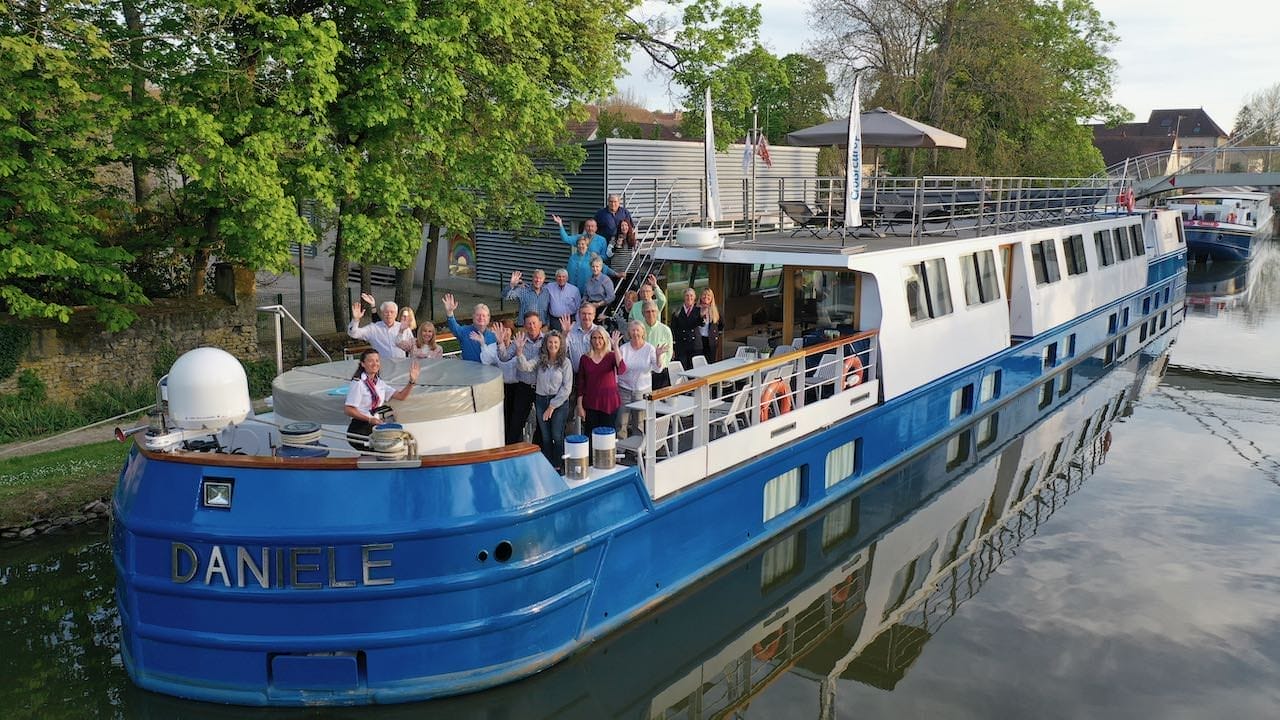
Our barge moves through the Oise Valley at the pace of the current, past wooded banks and flat meadows, past stone bridges and cathedral towns. It is one of the great pleasures of river travel — the way the landscape accumulates around you slowly, the way history surfaces not in monuments alone but in the very shape of the land.
On Day 2 of the cruise, we arrive in Compiègne.
The town sits on the left bank of the Oise River. Behind it lies the famous forest through which Joan rode one night in May 1430, arriving in the pre-dawn hours to the great relief of the townspeople. The city had refused to transfer allegiance to the Duke of Burgundy — a brave and dangerous decision — and the duke had laid siege to it. Joan, sensing the danger before the king did, assembled a company of 300 to 400 volunteers and departed for Compiègne, possibly without the king’s knowledge, arriving May 14.
For nine days she fought. She pushed the Burgundian forces back. She moved through this landscape we now traverse by water — across bridges, through the flat meadows on the right bank, along the causeways built above the flood plain.
On the evening of May 23, 1430, everything changed.
Joan rode out with her force, crossed the bridge and drove through the Burgundian positions. But reinforcements arrived from multiple directions, and the French commanders ordered a retreat. Joan disagreed. She wanted to keep fighting. The commanders refused.
What happened next has been argued over for nearly 600 years. The governor of Compiègne ordered the city gates closed before the rearguard — including Joan — could reach safety. Whether this was treachery or an act of prudence to prevent the Burgundians from storming the gate has been debated ever since. An archer pulled Joan from her horse and onto the ground. She was captured.
The peasant girl, the seer, the soldier, seized by Burgundian troops and sold to her enemies.
She was 18 years old.
Walking Compiègne’s streets that damp May morning — past the faded ghost sign of the Café Français painted on a limestone facade, past the medieval home called La Vieille Cassine built in the 15th century, past the café tables being set out in the quiet squares — it was impossible not to feel the weight of it. History doesn’t always announce itself with monuments. Sometimes it just settles into the stones.
The town hall in the square where I stood is the same Gothic structure, rebuilt and restored across the centuries, that would have defined Joan’s Compiègne. The bell in the tower was already ringing when she rode through here. The river was already where it is.
The Armistice Memorial — and Another Layer of History
Our excursion took us also to the Armistice Memorial in Compiègne’s forest, and here the city reveals another dimension. In a clearing in those same woods where Joan once rode, the armistice ending World War I was signed in November 1918 — in a railway carriage, at 5 a.m., while soldiers were still dying at the front. The last French soldier killed in that war, Augustin Trébuchon, fell just before 11 a.m. on November 11, 1918, the morning of the armistice.
Then, in a vindictive act of historical theater, Hitler had that same railway carriage brought back to the identical spot in June 1940, and forced the French to sign their own surrender in it.
The memorial holds the carriage — a replica; the original was destroyed by the Germans before the end of the war — along with a Marne Taxi requisitioned to transport troops in 1914 and 800 stereoscopic photographs from the war years. It is sobering and precise and does not flinch.
Compiègne, it turns out, has been at the center of French history with a frequency that borders on the cosmic. Joan of Arc. The armistice. The surrender. You walk these streets carrying several centuries at once.
The Long Road to Rouen
The Burgundians held Joan for months, moving her from castle to castle, before selling her to the English for 10,000 livres. She endured a politically charged trial in Rouen from January to May 1431, accused of heresy, witchcraft and wearing male clothing. She defended herself eloquently and at length before a court of learned doctors and theologians — all of them operating in service of an English regime that needed to discredit the girl who had turned the tide of their war.
The trial transcripts survive. We know what was said to her, and what she said back. She was, by every account, formidable.
The court found her guilty of heresy. She was burned at the stake on May 30, 1431. She was 19. Her ashes were thrown into the Seine, with no grave to mark, no resting place to become a shrine. Her executioners intended to erase her. They did the opposite.
What Rouen Holds
Rouen is roughly 90 miles northwest of Compiègne, and it is where Joan’s story ends. It is also, improbably, where one of the great American culinary careers began. The city sits on the Seine, and larger river cruise ships call there regularly on Seine itineraries — making Rouen the natural complement to the Oise barge experience. Sail the intimate river first, on the barge, close to the water and the meadows and the history at human scale. Then return on a Seine cruise and find the story waiting for you, cast in light on the facade of the tallest cathedral in France.
The Place du Vieux-Marché was the site of Joan’s execution in 1431. Today it is a lively square of cafés, market stalls and half-timbered houses. At the western end, a 65-foot Iron Cross of Lorraine rises above the roofline, placed on the exact spot where archaeological evidence indicates Joan was burned. The Church of Saint Joan of Arc — built in 1979, its sweeping curves referencing the flame that consumed her on this spot — stands adjacent. Some see the building’s shape as an overturned longship. Others see a pyre. Inside, stained-glass windows fill the space with shifting color throughout the day.
If you visit in summer — and for this cruise, you will — stay in Rouen after dark.
Every evening from mid-June through mid-September, the western facade of Rouen Cathedral becomes a canvas for the “Cathedral of Light” show, projected free of charge onto France’s tallest cathedral. The show has two parts. The first, called Première Impression, is about Impressionism — a fitting subject, since Claude Monet painted this same facade more than 30 times between 1892 and 1894, returning again and again to study how light moved across the stone at different hours of the day. Those paintings — gray at dawn, gold at midday, violet and orange at dusk — are among the most celebrated series in art history. Monet wasn’t painting the cathedral so much as painting light itself, using the cathedral as his fixed subject and letting the atmosphere do everything else.
The second part of the show is called Jeanne(s). Joan’s story — her voices, her victories, her capture and trial and death — is cast in light and color across the same facade that obsessed Monet. The building that he spent years painting by day becomes, at night, the surface on which Rouen tells her story to anyone who will stand and watch.
It is free. It runs all summer. You stand in the square with locals and tourists, on the same cobblestones where the medieval city went about its business, and the cathedral does something it has been doing in one form or another for 900 years: it holds the light.
Walk a short distance to the archbishopric palace, now the Historial Jeanne d’Arc museum, where Joan’s two trials were actually held. The museum uses projection technology to transform the ancient walls into the very courtroom — you hear excerpts from the trial transcripts read aloud, see the faces of the prosecutors, stand in the room where the sentence was pronounced. It is 110 minutes well spent.
And then, when you step back out into the Place du Vieux-Marché, you will find, facing the square, a half-timbered auberge called La Couronne.
It was founded in 1345. It is the oldest inn in France.
On November 3, 1948, Julia Child and her husband Paul stopped for lunch at La Couronne after their ferry landed at Le Havre and they began the drive to Paris. It was the first meal Julia had on French soil. She was served oysters on the half-shell with rye bread and Normandy butter, followed by sole meunière in brown butter. She later wrote in her memoir My Life in France that it was “the most exciting meal of my life.” It set the course of everything that followed — the cooking school, the cookbooks, The French Chef, an entire American relationship with French cuisine.
La Couronne still serves a prix-fixe menu recreating that exact meal, the menu printed alongside the passage from Julia’s memoir where she describes it.

So in one square in Rouen, you have three extraordinary stories converging across five centuries: Joan of Arc was burned here in 1431. The church built on that spot was inaugurated in 1979. And the restaurant across the square — open since 1345, older than Joan herself — is where Julia Child discovered what food could be.
History accumulates in places. Rouen holds more than most.
Sailing On
The Oise Valley cruise continues well beyond Compiègne. We pass through the Château de Chantilly, one of the most beautiful castles in France, with its art collection undisturbed since the 19th century and its reading room holding one of the most extensive libraries in the country. In Auvers-sur-Oise, we walk the Artists’ Pathway where Van Gogh spent his final days, the landscapes he painted still recognizable around us. We visit the Maison-Atelier de Daubigny, where Corot and Daumier and Berthe Morisot gathered in the 1860s. We tour the Château de Malmaison, where Joséphine de Beauharnais lived and died. We end with a night cruise through Paris.
It is a remarkable seven days, layered with history and art and very good French food. A masterclass in crème chantilly, prepared by hand, by a member of the Confrérie des Chevaliers Fouetteurs. An absinthe tasting at the Musée de l’Absinthe in Auvers. A gala dinner somewhere on the river with Paris approaching in the dark.
But I keep returning to Compiègne, to that square, to that statue.
She was 18 when she was captured on the banks of this river. She was 19 when she died. She could not read.
France remembers her the way it remembers no one else. And here, on the quiet Oise, with the meadows passing on either side and the current doing the work, so should we.
Read about the entire barge trip, Six Nights/Seven Days Barging the Oise River

About This Series
What The Rivers Remember is an ongoing series exploring the people and forces that shaped Europe’s great waterways — the queens, soldiers, emperors and explorers whose stories are written into the rivers that river cruisers sail today. Each installment follows one river, or a constellation of rivers, tracing European history from the water rather than the shore excursion. [Read the series introduction → What The Rivers Remember]
Articles in this series:
— The River Remembers: On The Oise, Joan Of Arc
— Bordeaux River Cruise: Eleanor Of Aquitaine’s Story
— The Seine: Richard, Monet and the Chalk Cliffs of Normandy
— The Rhône and Saône: Caesar, Hannibal and the Roman Corridor
— The Rhine: Charlemagne, the Border That Shaped Europe
— The Danube: The Habsburgs and the Connected Continent
— The Douro and Tagus: Henry the Navigator and the Edge of the Known World
— The Sources: Where Europe’s Rivers Begin


