
A river cruise traveler’s guide to the people, places and stories that shaped Europe’s great waterways
I grew up in a world that had edges.
My father cut timber for a living, and the men I knew growing up measured the world in cords of wood and the distance to the sawmill. Nobody talked about Europe. Nobody talked about rivers with Roman temples on the river banks or medieval castles on clifftops or wine that had been made in the same valley for 1,000 years – and transported on rivers. That world was not available to us, or if it was, we didn’t know it. The world I grew up in was small and complete in itself, or so I thought. For a long time I had no reason to think there was anything beyond its edges.
Then I was 20, and I had a bicycle, and somehow I found myself in Europe, and the edges disappeared.
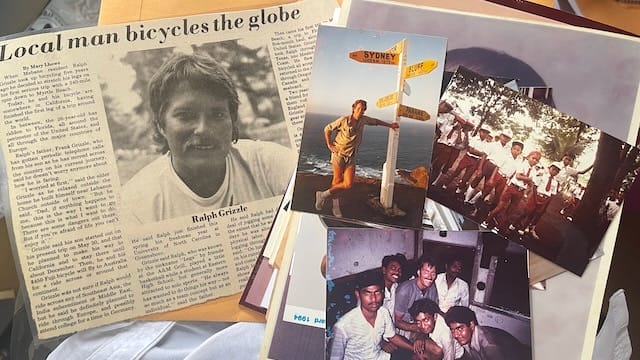
I didn’t understand most of what I was seeing. I didn’t know who had built the things I was pedaling past or what had happened there or why it still mattered. But I felt it — the weight of it, the age of it, the sense that the world I had grown up in was very narrow and very small and that there was something else, something older and stranger and more complicated, that I had not been told about. I pedaled through valleys where the vines had been planted before America existed. I crossed bridges that had been crossed by armies I had never heard of. I passed through towns where the cathedral was older than my small town by a thousand years.
I didn’t have the words for what was happening to me. I only knew that I was not the same person who had gotten on the bicycle, and that I was not going back.
I have spent the fifty years since then trying to understand what I felt on that first ride.
The understanding has come slowly, in pieces, in places I did not expect.

Standing in front of the Palace of the Dukes of Burgundy in Dijon this past April, I thought about power — the Valois dukes who for a century ruled a territory stretching from Burgundy to the North Sea, whose wealth flowed down the Saône and the Rhine in the form of wine and cloth and ambition.
The year before, Marucia and I had stood in the courtyard of the Papal Palace in Avignon, where the popes had fled Rome in the 14th century and built a fortress on the Rhône that still feels, seven centuries later, like an act of defiance. The Roman history along that same river is written in stone everywhere you look — in the amphitheater at Arles, the temple at Vienne, the impossible engineering of the Pont du Gard spanning its gorge as if the empire had never ended.

On the Seine I had sailed past the chalk cliffs at Les Andelys, where the ruins of Château Gaillard cling to the hillside above the river bend — the castle Richard the Lionheart built in two years as a provocation to the French crown, lost the year his mother Eleanor of Aquitaine died.
On the Danube I had seen the castle at Dürnstein, where that same Richard had been held for ransom on his return from Crusade, his mother crossing the Alps in winter to bring him home. Eleanor I had come to know on the Garonne, where she was born and where the mascaret still surges up the estuary with enough force to snap a mooring line, and where you begin to understand that this is a powerful river that gave birth to a powerful woman.

Each piece was real and vivid on its own. But I could feel them connecting to something larger without quite being able to see what it was.
It came together for me in Madrid, in a room in the Prado, standing in front of Las Meninas.
Marucia and I had been looking at the painting for several minutes — Velázquez’s great canvas of the Spanish court, the little Infanta at its center surrounded by her ladies-in-waiting, the painter himself watching from behind his easel — when I felt the thread pull taut. The child in that painting is a great-granddaughter of Charles V, the Habsburg emperor who ruled the Danube and the Rhine and the Douro simultaneously, whose empire stretched from the Black Forest to the Tagus estuary to the plains of Hungary. I had sailed most of those rivers. I had stood on their banks without quite understanding what connected them. And here, in a painting made in 1656 in a city with no river, it finally became clear.
Europe had been woven together by water.
Not only by water, of course. By war, by marriage, by faith, by the ambitions of men and women who understood that whoever controlled the rivers controlled the continent. But the rivers were always there — as highways, as borders, as the routes along which everything moved: armies, merchants, pilgrims, ideas, wine, grain, the letters of kings. Long before there were railways or roads worth the name, there were rivers. And the rivers remembered everything.
The 20-year-old on the bicycle had felt this without being able to name it. The weight, the age, the sense of something older and more complicated than anything he had been told about. What I was feeling, without knowing it, was the accumulated memory of 2,000 years of European civilization, written in stone and vine and water. It had taken me 50 years to find the words.
But the rivers are not only the stage for medieval drama and imperial ambition. They are witnesses to something darker and more recent, and many of the travelers who sail them know this better than anyone.
The Rhine, which the Romans decided would make a convenient border between civilization and the east, became in the 20th century the line that two world wars were partly fought across. American forces crossed it at Remagen in March 1945 — the first hostile crossing since Napoleon — and the moment still carries the weight of everything that preceded it: four years of occupation, the systematic murder of millions, a continent that had decided, for the second time in 30 years, to destroy itself.
The Danube flows through or borders ten countries, and every one of them carries the memory of occupation, resistance, liberation and loss. The bridges at Novi Sad were bombed in 1999; at Budapest they were destroyed in 1945 and rebuilt, stone by stone. The Seine carried the weight of occupation for four years and then, in August 1944, liberation. To sail these rivers is to move through a landscape that has not forgotten what happened to it.
Many of the river cruise passengers I have met are drawn by this history. They are people who understand that the beauty of these places was purchased at a price. They stand on the banks of the Rhine at Remagen and try to imagine what it cost to cross it. They sail past the Hungarian plain and think about what the Danube witnessed in the winter of 1944. They are right to look. The rivers saw all of it.
And yet Europe rebuilt. The rivers that had been crossed by armies were crossed again by tourists. The cities that had been bombed were reconstructed, sometimes stone by stone. The continent that had torn itself apart twice in 30 years built something new — imperfect, contested, still incomplete, but rooted in the conviction that what had happened must not happen again.
The same Rhine that had been a military objective became a symbol of reconciliation. The Main-Danube Canal, completed in 1992, finally realized what Charlemagne had attempted 12 centuries earlier: a continuous waterway from the North Sea to the Black Sea, the continent connected from one end to the other by water. The rivers that had divided now connected. They still do both, depending on which bank you stand on, and the tension between those two facts is part of what makes them worth sailing.
What the Rivers Remember is an attempt to read European history from the water — to give river cruise travelers the longer story that the shore excursions rarely have time to tell. Each article follows one river or one constellation of rivers, organized not by departure date or cabin category but by the people and forces that made these waterways matter.
The series begins on the Oise, where a girl from Lorraine who had turned the war rode out from Compiègne and the drawbridge rose behind her and the Burgundians pulled her from her horse in the meadows along the river. It will move to the Garonne and Dordogne, the rivers of Bordeaux where Eleanor of Aquitaine was born. To the Seine, where her son’s ghost still haunts the chalk cliffs at Les Andelys. To the Rhône and Saône, where Caesar built his empire and Hannibal crossed with his elephants and the popes built their palace above the flood plain. To the Rhine and the Danube and the canal that finally joined them, twelve hundred years after Charlemagne first imagined it. To the Douro and the Tagus, where the Portuguese sent their ships to the edge of the known world and came back with everything that made the Habsburgs rich. And eventually to the sources — the springs and glaciers in the mountains where these great rivers begin as something you could step over, before they widen into history.
I did not plan any of this when I was 20, riding my bicycle through a continent I didn’t yet understand. I was just a logger’s son from a small town, and the world had turned out to be so much larger than anyone had told me. The rivers were there then, as they are now. They were already old when I first saw them. They will be here long after the cruise ships are gone.
They have been waiting a long time to tell this story. I have been traveling long enough to finally be ready to listen.

About This Series
What The Rivers Remember is an ongoing series exploring the people and forces that shaped Europe’s great waterways — the queens, soldiers, emperors and explorers whose stories are written into the rivers that river cruisers sail today. Each installment follows one river, or a constellation of rivers, tracing European history from the water rather than the shore excursion. [Read the series introduction → What The Rivers Remember]
Articles in this series:
— The River Remembers: On The Oise, Joan Of Arc
— Bordeaux River Cruise: Eleanor Of Aquitaine’s Story
— The Seine: Richard, Monet and the Chalk Cliffs of Normandy
— The Rhône and Saône: Caesar, Hannibal and the Roman Corridor
— The Rhine: Charlemagne, the Border That Shaped Europe
— The Danube: The Habsburgs and the Connected Continent
— The Douro and Tagus: Henry the Navigator and the Edge of the Known World — coming soon
— The Sources: Where Europe’s Rivers Begin — coming soon


