
This sixth installment of our What The Rivers Remember series follows On The Oise, Joan Of Arc, The River That Shaped Europe: Sailing Eleanor Of Aquitaine’s Bordeaux, The Seine: Richard, Monet and the Chalk Cliffs of Normandy, The Rhône and Saône: Caesar, Hannibal and the Roman Corridor and The Rhine: Charlemagne and the Border That Shaped Europe, which left us with a river turned into a border, dividing a continent along lines still visible today. This one runs the other direction. It follows a family that spent 600 years using a river to hold a continent together instead.

The Habsburgs did not conquer their way to power on the Danube so much as marry, inherit and administer their way there, one dynastic match and one careful compromise at a time, until a single family ruled Germans, Hungarians, Czechs, Poles, Italians, Croats, Romanians and a dozen other peoples from a run of cities strung along one river.
For six centuries the Danube was the empire’s spine, the water that let Vienna govern Budapest and Budapest answer Vienna, in a currency, a language of administration and, eventually, a single Habsburg crown worn by two different kings. When it finally came apart, in 1918, it broke roughly along the river’s own tributaries and the nations that had grown up beside them — proof, in reverse, of how completely the water had held the place together in the first place.
A Castle Won on the Marchfeld
The Habsburgs arrived on the Danube almost by accident. Rudolf I, a minor count from what is now Switzerland, was elected King of the Germans in 1273 largely because the electors judged him too weak to threaten anyone. Five years later, on the Marchfeld plain northeast of Vienna, Rudolf’s army defeated and killed Ottokar II of Bohemia, the ambitious king who had seized Austria after the old Babenberg dynasty died out. Rudolf took the lands for himself and moved his family into the Babenbergs’ old castle on the Danube — a port city already thriving on river trade between Central Europe and the Adriatic. It was a modest beginning for a family that would go on to rule more of Europe than any dynasty before or since, and it happened because a river town needed a new landlord and Rudolf was standing closest.
Let Others Wage War
The Habsburgs’ real weapon was never the army. It was the wedding. “Bella gerant alii, tu felix Austria nube” — let others wage war, you, happy Austria, marry — became the line historians reach for because the Habsburgs themselves seemed to live by it, most spectacularly under Maximilian I at the end of the 15th century.
Maximilian’s own marriage brought Burgundy into the family. He married his son Philip the Fair to the heiress of Spain and its new American empire, and married his grandson Ferdinand to the heiress of Bohemia and Hungary. Within two generations, without fighting a war of conquest for any of it, the Habsburgs held Austria, Burgundy, Spain, the Spanish colonies, Bohemia and Hungary — an empire assembled almost entirely through paperwork and children.
Vienna sat at the center of that patchwork not because it was the biggest of the Habsburg cities but because it was the river city, the point where goods and administrators moving between the Germanic west and the Hungarian, Bohemian and Balkan east all had to pass. The Danube did not make the Habsburgs powerful. It made the empire they married their way into governable — one water route tying together lands that shared no common language, in an era when a message could travel only as fast as a boat or a horse could carry it.
The River the Ottomans Couldn’t Cross
That river also made Vienna a target. The Ottoman Empire, expanding up the Balkans through the 16th and 17th centuries, understood exactly what the Habsburgs understood: whoever held the Danube at Vienna controlled the trade routes into Germany and the overland approach to the rest of Central Europe. Suleiman the Magnificent besieged the city in 1529 and failed. A century and a half later, on July 14, 1683, an Ottoman army numbering roughly 150,000 arrived at Vienna’s walls for a second attempt, and this time the siege ran two months, the city’s defenders reduced to a garrison of a few thousand holding out on rumor of relief.
The relief came on September 12, when a combined force under the Polish king John III Sobieski, including the largest cavalry charge in European history, broke the siege from the high ground at Kahlenberg above the city. Historians still mark it as the hinge point of the three-hundred-year Habsburg-Ottoman conflict — the moment Ottoman expansion into Central Europe stopped and, over the following decades, reversed, as Habsburg armies pushed south and retook Hungary and much of the Balkans. Vienna held the river. The river, in turn, is the reason there was a Vienna worth holding.
Two Capitals, One River
By the 19th century the empire the Habsburgs had married and fought their way into had grown too large and too diverse to govern from one throne alone, and in 1867 Emperor Franz Joseph agreed to the Compromise that split it into a Dual Monarchy — one crown, two governments, two parliaments, two capitals, both on the same river. Vienna kept the Austrian half. Budapest, roughly 150 miles downstream, got its own government, its own parliament and, for the first time since the Ottoman wars, its own coronation.
That coronation, on June 8, 1867, crowned Franz Joseph and his wife, Elisabeth — Sisi, to history — as King and Queen of Hungary at Matthias Church on Buda’s Castle Hill, with the imperial household’s boxes and furnishings shipped down from Vienna by Danube steamer for the occasion.
Elisabeth had pushed for the Compromise harder than almost anyone at court; she had taught herself Hungarian at a time when most Habsburgs considered it beneath them, befriended the Hungarian statesman Gyula Andrássy, and made herself, deliberately and against considerable Viennese resentment, into Hungary’s favorite Habsburg. The grateful Hungarian parliament gave her Gödöllő Castle outside Budapest as a coronation gift, and a bridge across the Danube in the capital still carries her name.
Two capitals, joined by one dynasty, one currency and one river that a steamer could cover between them in a day — the Danube functioning, for the last half-century of the monarchy, almost exactly the way its Habsburg subjects liked to imagine it: not a border, but a connection.
Where The River Runs Out
The empire the Danube had held together for six centuries came apart in four years. A Bosnian Serb nationalist shot the heir to the Habsburg throne, Archduke Franz Ferdinand, in Sarajevo on June 28, 1914 — a killing that happened nowhere near the Danube, on a tributary of the Bosna, but that set off the mobilization chain that became the First World War. Austria-Hungary spent the war fighting on the losing side and unraveling internally as its constituent nationalities, encouraged by wartime propaganda about self-determination, stopped waiting for Vienna’s permission to imagine themselves as separate countries. The last Habsburg emperor, Charles I, renounced participation in state affairs in November 1918, without formally abdicating, and the monarchy simply stopped existing.
What replaced it mapped, with striking precision, onto the river system the Habsburgs had spent centuries knitting together. Austria and Hungary split into two much smaller republics. Czechoslovakia, Poland, and the new Kingdom of Serbs, Croats and Slovenes absorbed the rest, each drawn roughly along the lines of the Danube’s own tributaries and the nations that had grown up along them — the Vltava, the Morava, the Sava, the Tisza. The single river that had let one dynasty administer a dozen peoples from two capitals turned out, once the dynasty was gone, to be exactly where the seams already were.
The Lines & Where Ships Cruise
The Danube’s classic river cruise route runs Passau, on the German-Austrian border, to Budapest or the reverse — seven or eight nights, the single most popular itinerary in European river cruising, and for good reason: it is largely the Habsburgs’ own itinerary, town for town. AmaWaterways, Viking, Uniworld, Scenic, Avalon Waterways and CroisiEurope all sail it, most running through Linz, the Wachau Valley’s vineyard terraces at Dürnstein and Melk Abbey’s Baroque library perched above the river, Krems, Vienna and Bratislava before finishing in Budapest.
Vienna gets a full day or an overnight on nearly every itinerary, time enough for the Hofburg palace, St. Stephen’s Cathedral and, for travelers chasing this installment specifically, the Kaisergruft crypt where dozens of Habsburgs, Franz Joseph and Elisabeth among them, are buried beneath the Capuchin church.
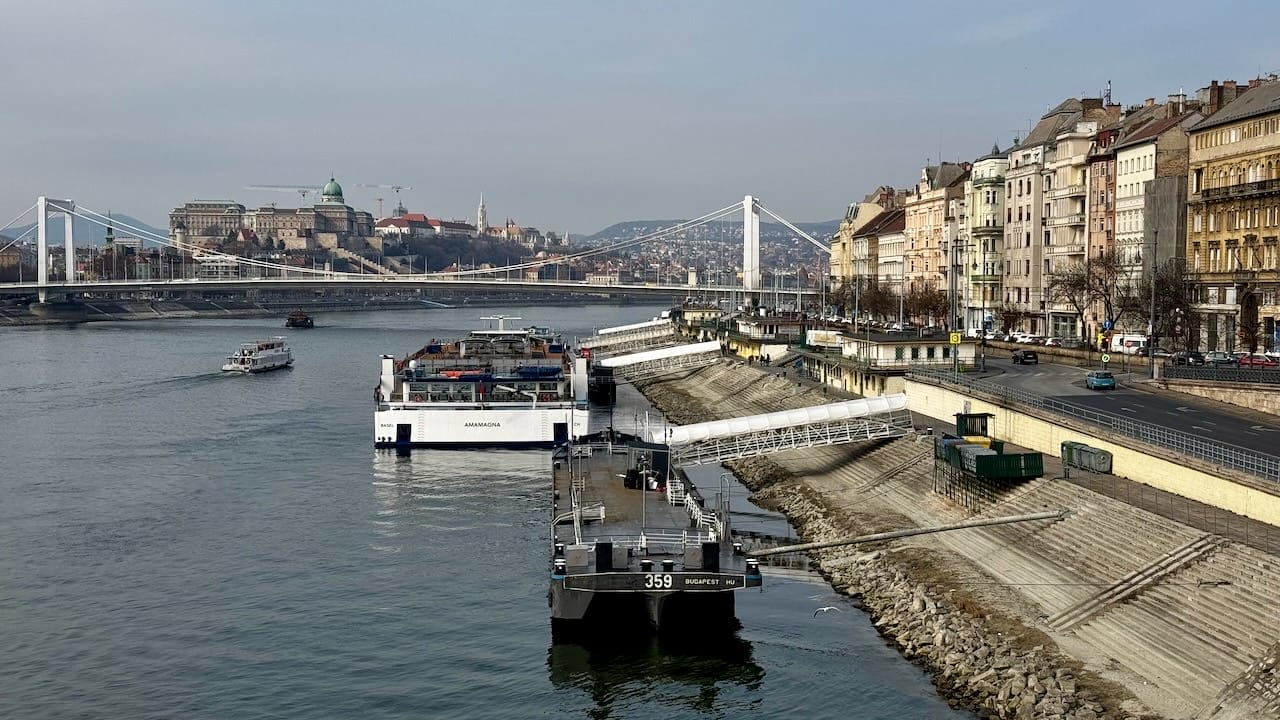
Budapest, usually the itinerary’s other overnight, pairs Castle Hill’s Matthias Church and Fisherman’s Bastion with the neo-Gothic Hungarian Parliament building across the river and, for anyone willing to look, the Elisabeth Bridge — named for her five years after her 1898 assassination in Geneva, rebuilt from scratch in a new design after German troops destroyed the original along with every other Budapest bridge in the last winter of World War II.
Bratislava, a shorter call between the two capitals, holds its own Habsburg coronation history: eleven Hungarian monarchs, Maria Theresa among them, were crowned at St. Martin’s Cathedral between 1563 and 1830, back when Ottoman control of Buda made Bratislava the safer seat for the Hungarian crown.
Viking’s Danube Waltz and AmaWaterways’ Best of the Danube both run some version of this route; between them and the rest of the fleet, a traveler can retrace, in a week, the geography it took the Habsburgs 600 years to assemble.
What The River Remembers
The Rhine, in the installment before this one, taught a river to be a border — a line Charlemagne’s own grandsons drew down the middle of an empire he’d spent his reign trying to hold as one piece. The Danube did the opposite for 600 years, longer than almost anything else in this series has managed: one crown, worn by one family, using one river to govern peoples who had no other reason to answer to the same government at all. It took a bullet in a city nowhere near the water, and a war that outlasted the family’s ability to hold the seams together, to prove that a river can only do that job for as long as everyone sailing it agrees to let it.
That is the thread running under all six installments of this series so far. Rivers do not decide whether they connect a place or divide it. The people who build their governments, their marriages and their armies along the water make that choice — and then, often enough, unmake it, while the river itself keeps running past both decisions, exactly as it always did.
Next: the Douro and the Tagus, where Henry the Navigator sent ships toward the edge of the known world.

About This Series
What The Rivers Remember is an ongoing series exploring the people and forces that shaped Europe’s great waterways — the queens, soldiers, emperors and explorers whose stories are written into the rivers that river cruisers sail today. Each installment follows one river, or a constellation of rivers, tracing European history from the water rather than the shore excursion. [Read the series introduction → What The Rivers Remember]
Articles in this series:
— The River Remembers: On The Oise, Joan Of Arc
— Bordeaux River Cruise: Eleanor Of Aquitaine’s Story
— The Seine: Richard, Monet and the Chalk Cliffs of Normandy
— The Rhône and Saône: Caesar, Hannibal and the Roman Corridor
— The Rhine: Charlemagne, the Border That Shaped Europe
— The Danube: The Habsburgs and the Connected Continent
— The Douro and Tagus: Henry the Navigator and the Edge of the Known World — coming soon
— The Sources: Where Europe’s Rivers Begin — coming soon


